Images Courtesy of Heritage Auctions, HA.com
1860-O Half Dollar, MS63
Indented by Half Dime Planchet
Spectacular Mated Error Pair
Available For Post-Auction Buy: $213,500.00
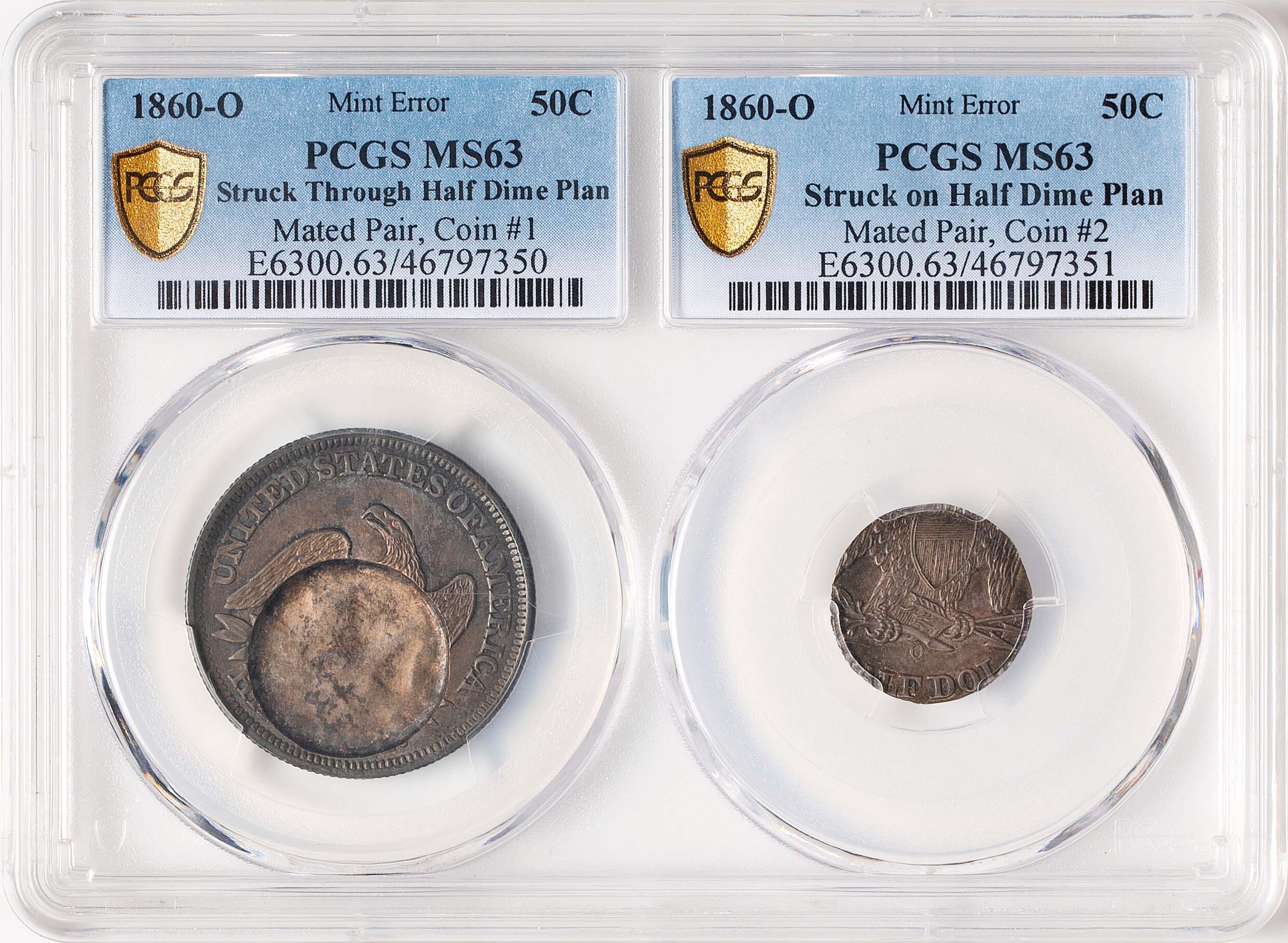
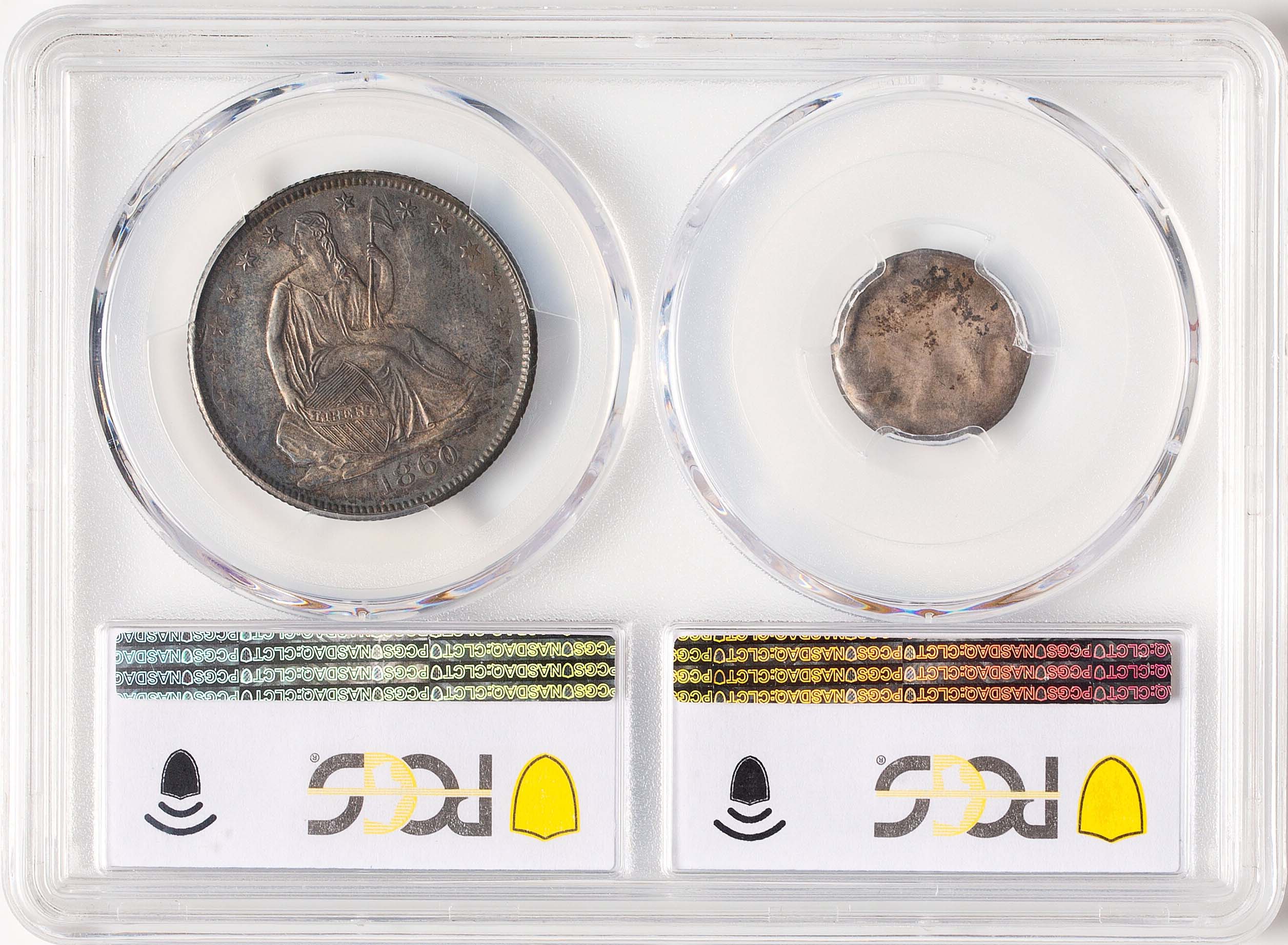
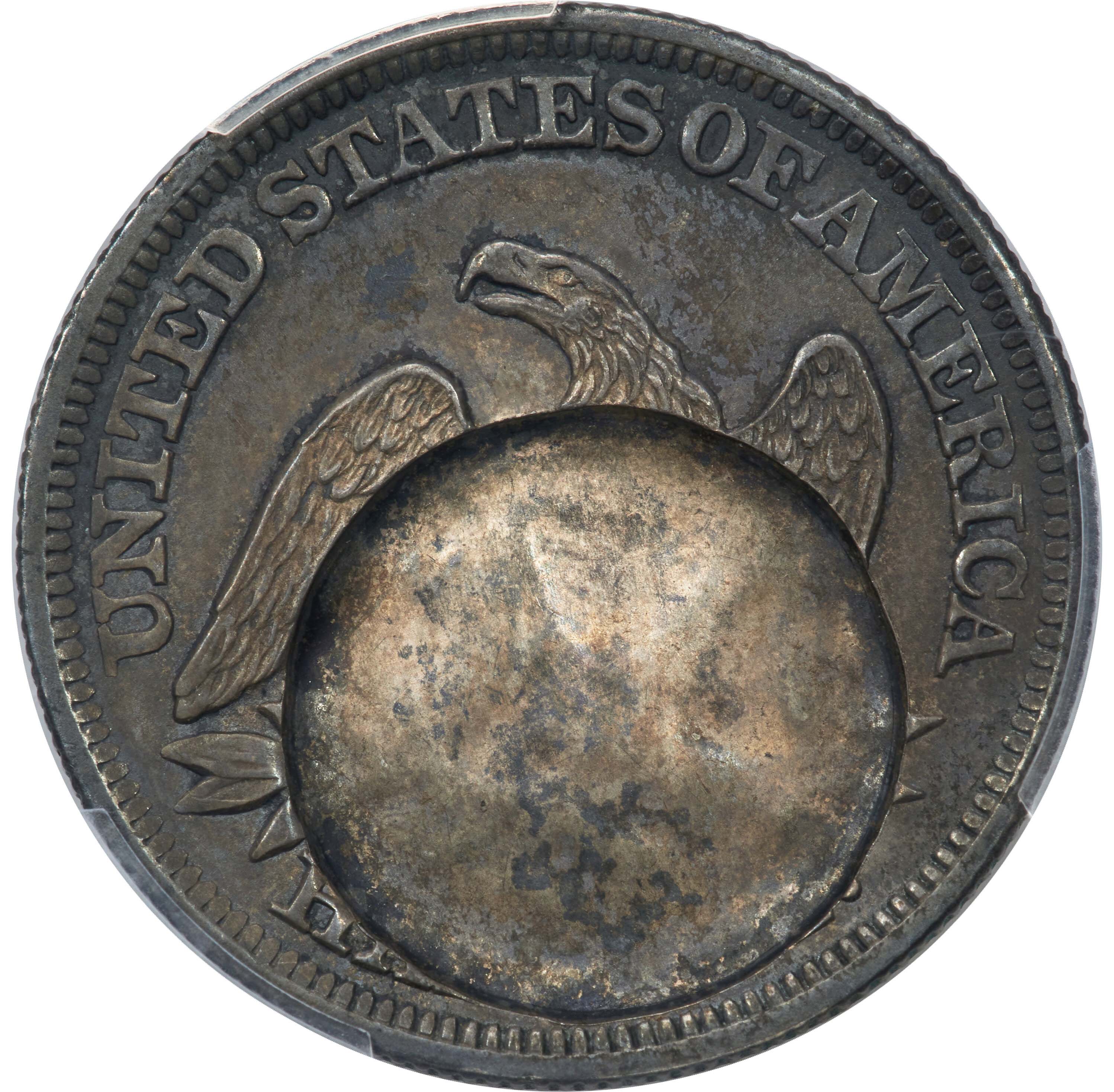
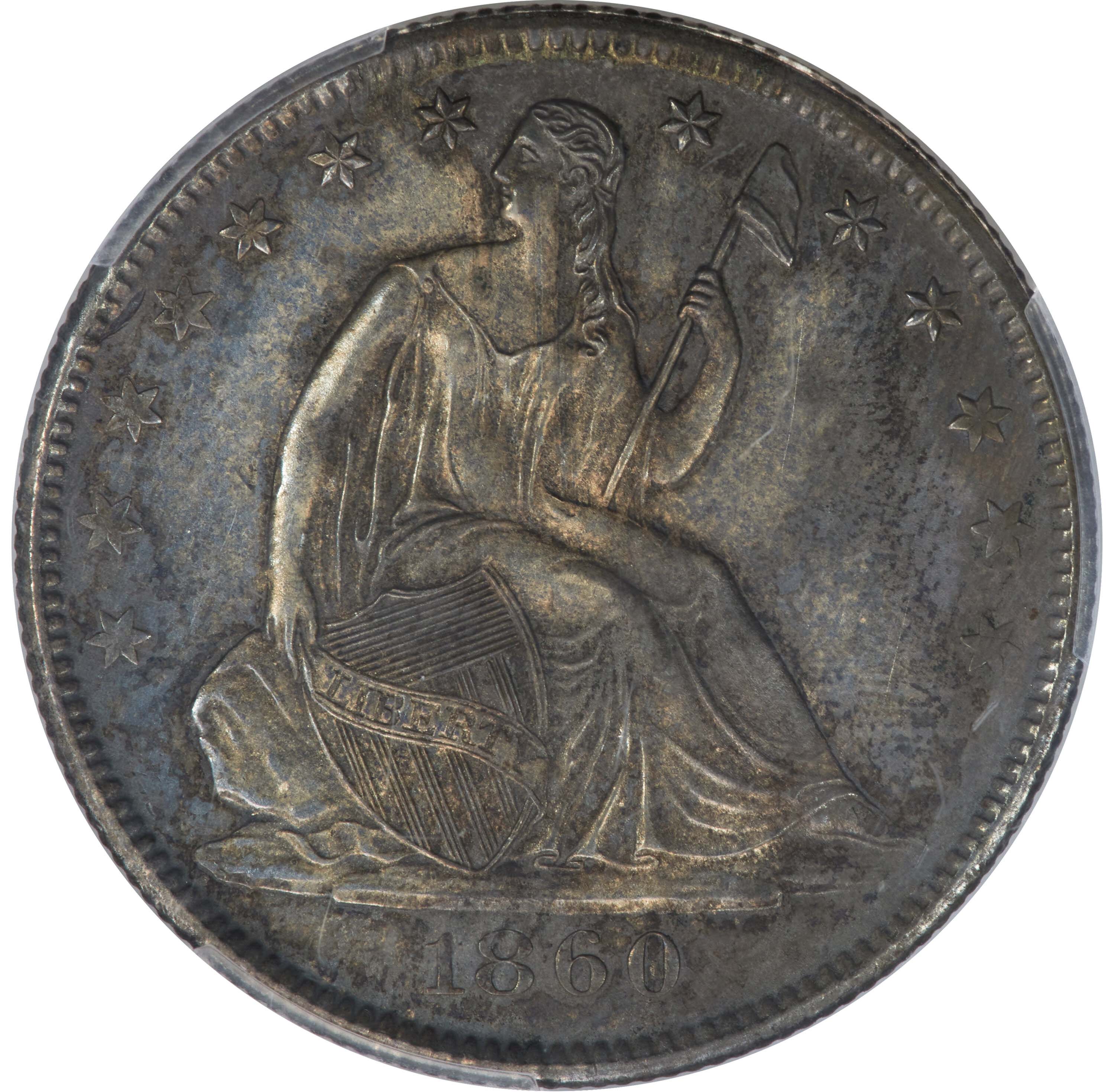
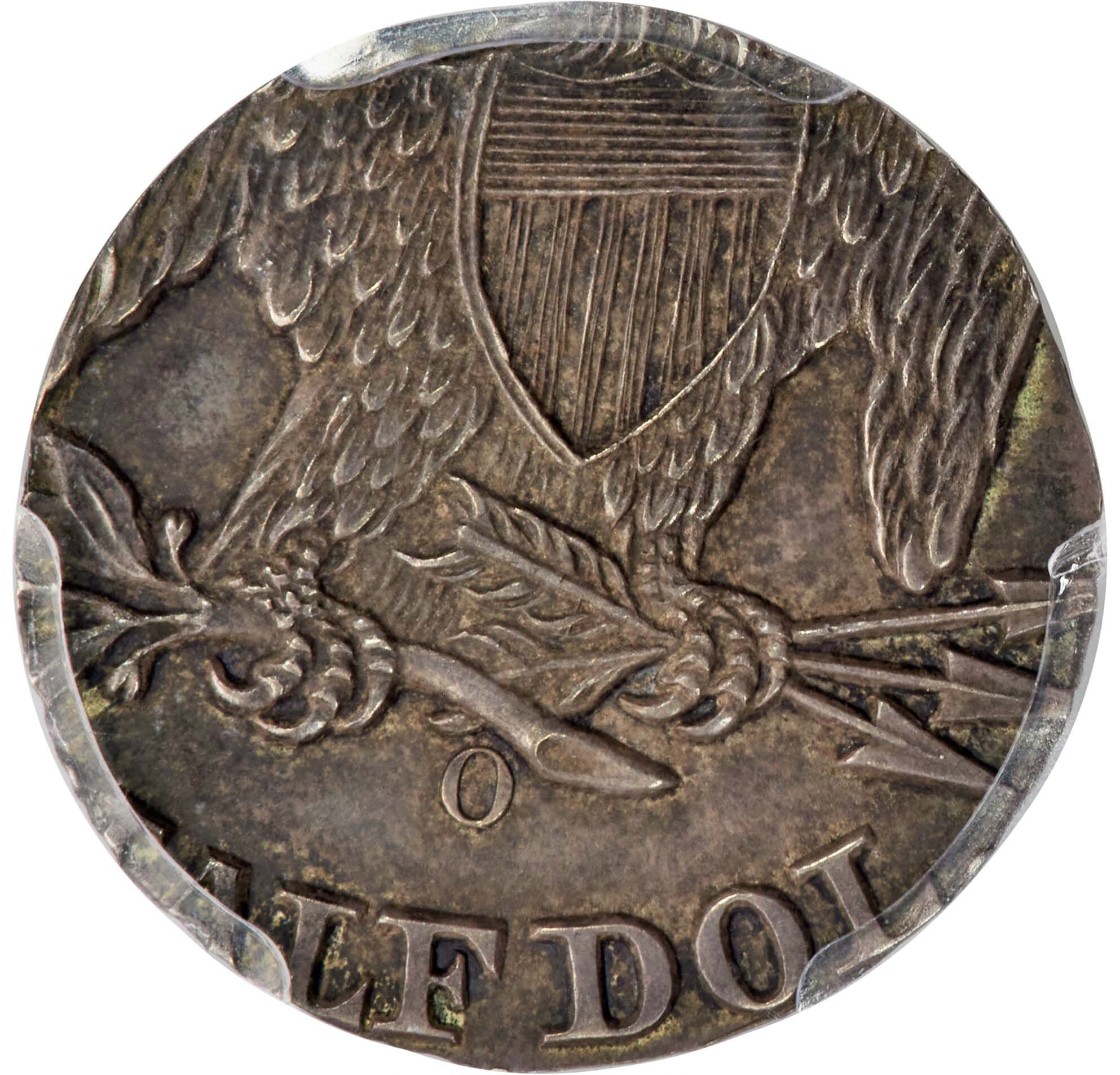
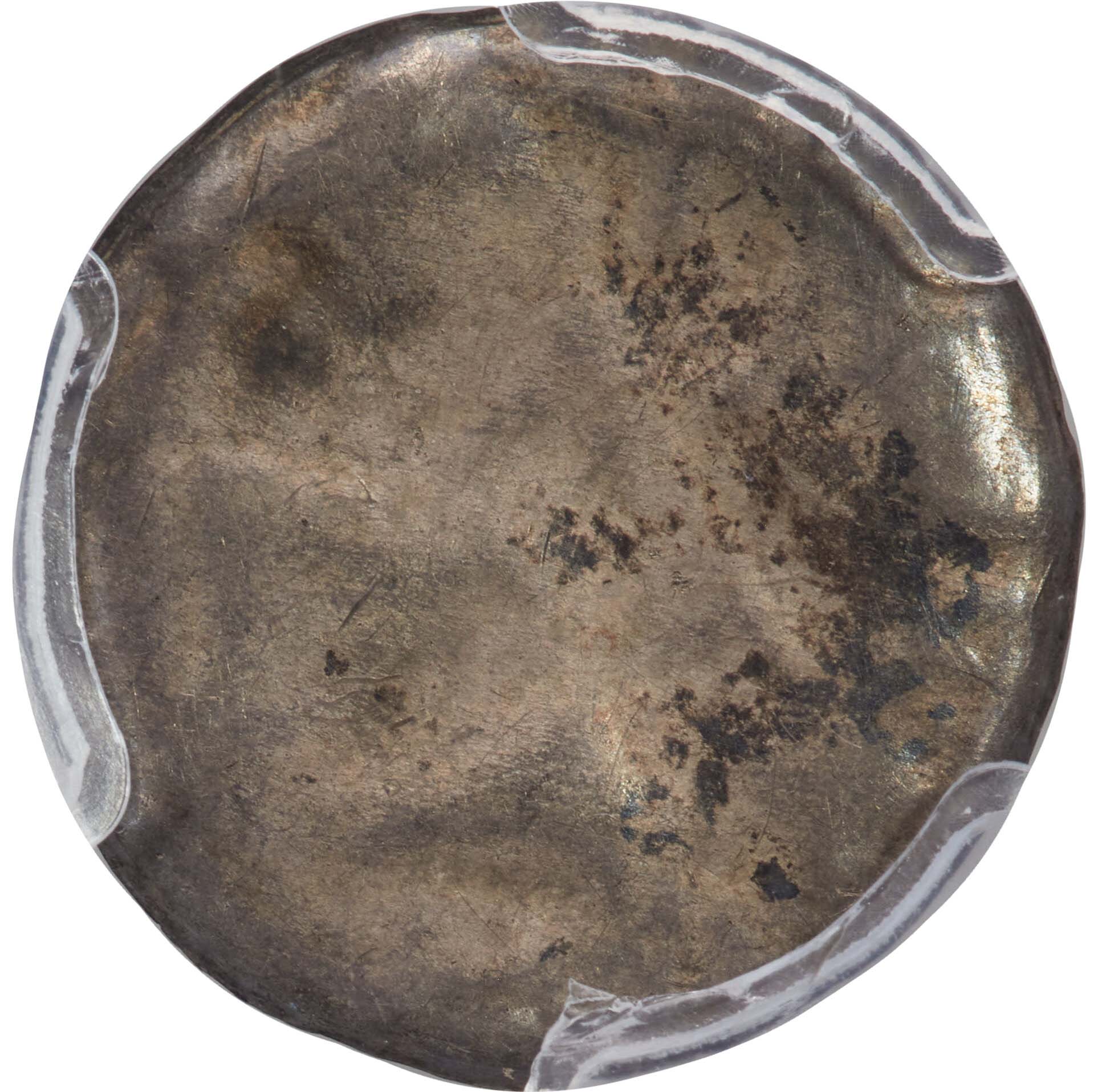
1860-O Half Dollar -- Indented by Half Dime Planchet, Mated Pair -- MS63 PCGS. Type One Reverse. WB-102, Die Pair 3, R.3. The "Weird Vertical Stripes" variety with crude vertical lines on the eagle's shield. An amazing mint error. A half dime planchet and a half dollar planchet were fed together between half dollar dies, with the half dime planchet situated between the half dollar planchet and the reverse die. The half dollar planchet was indented by the half dime planchet during the strike, creating a mated error pair. Each of the coins on its own would be a spectacular error find, yet the two coins have remained together since the year Abraham Lincoln was first elected President, and the Pony Express began its brief service.
The "fifty-five cent piece" displays rich steel-gray, walnut-brown, and cobalt-blue toning across the obverse. The reverse displays medium russet-red and lavender toning that deepens at the margins. The obverse has a normal appearance aside from a small pod-shaped strike-through near star 4. The lower stars are lightly brought up, but the strike is needle-sharp on Liberty's hair and adjacent stars. The reverse of the half dollar displays the large circular recession where it was indented by the half dime. The half dime is uniface reverse and shows all of the eagle's shield, claws, and tail, as well as the mintmark and most of the arrows and HALF DOL.
The only comparable mated pair we could find in Heritage's auction archives is a 1973-S Ike dollar indented by an unidentified 1.73 gram planchet. That coin appeared as lot 3523 in our January 2008 FUN Signature and realized $40,250. The present mated pair, struck at the New Orleans Mint from Seated dies and offered in today's market, is certainly worth considerably more.
1922 Modified High Relief Peace Dollar
Judd-2020, MS65 CAC
The '3200' Specimen
Ex: Mint Director Raymond T. Baker
Sold For: $213,500.00
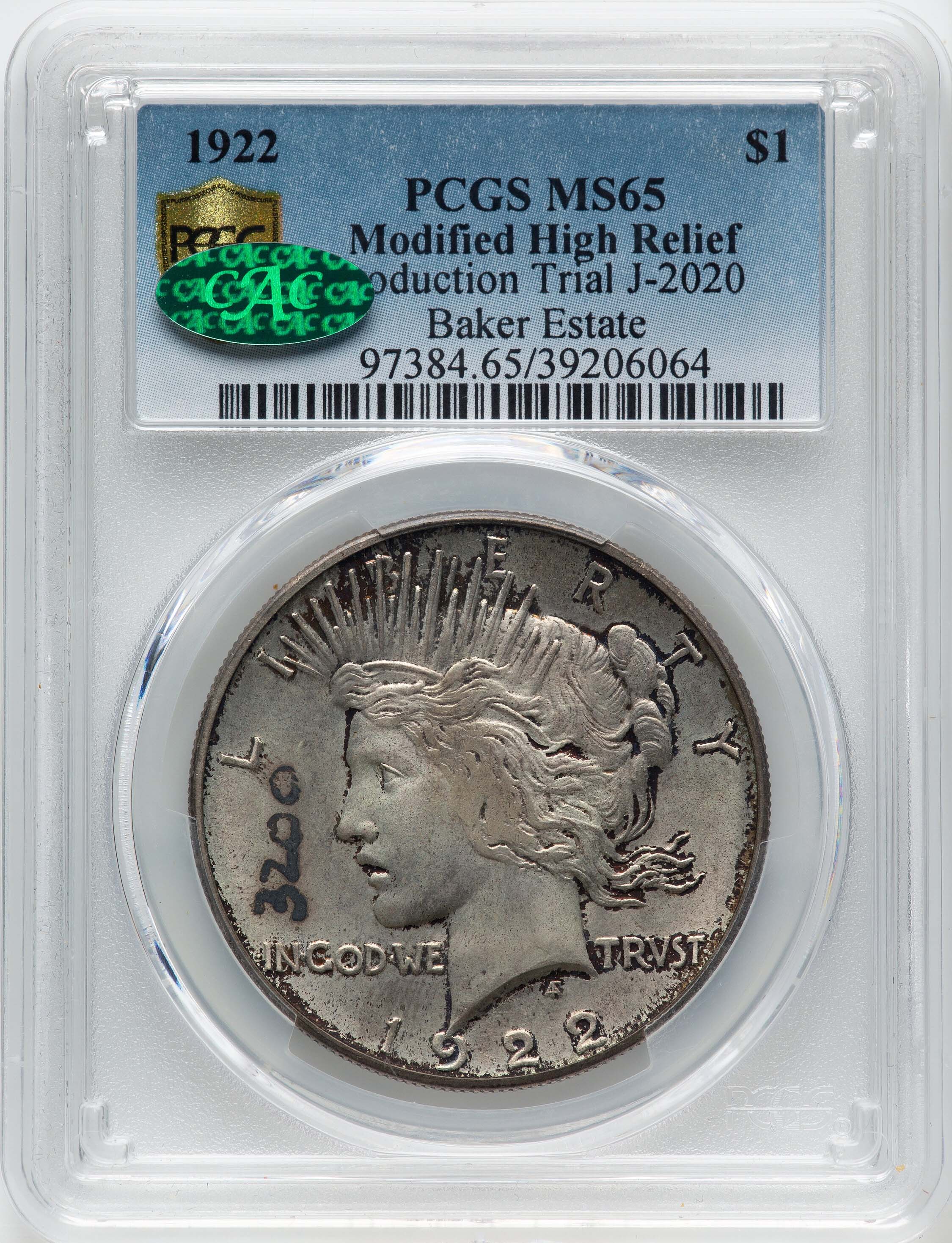
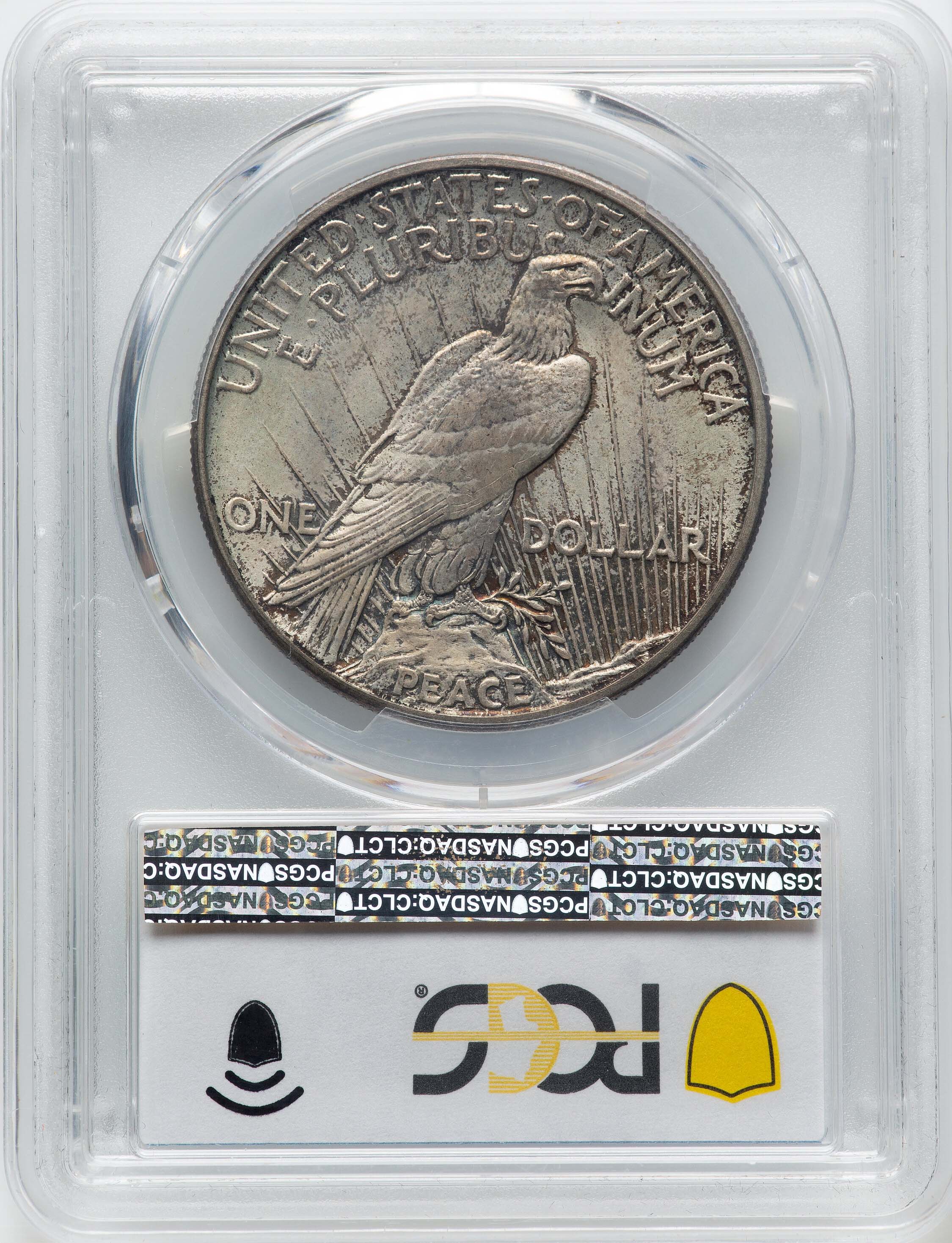
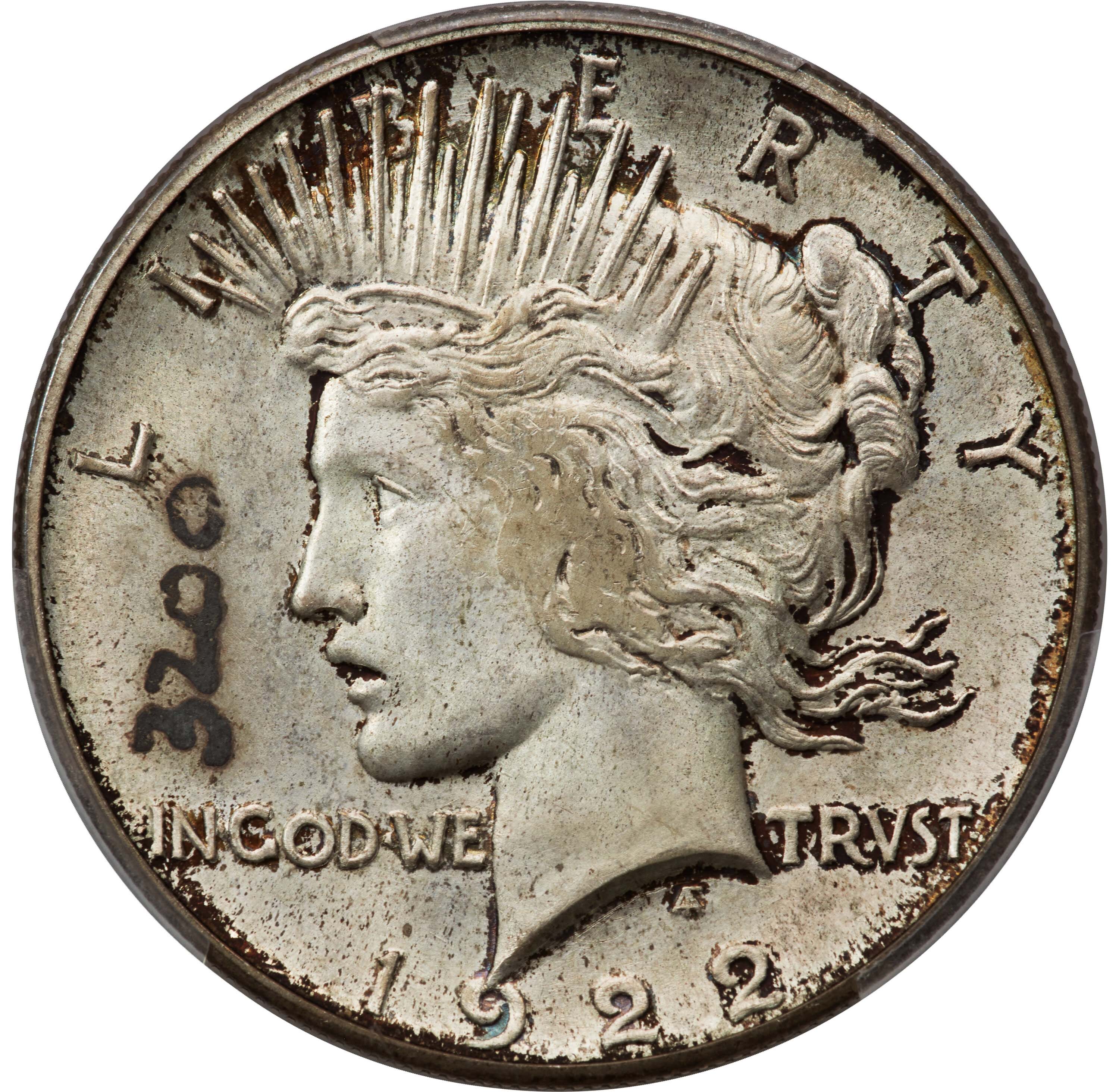
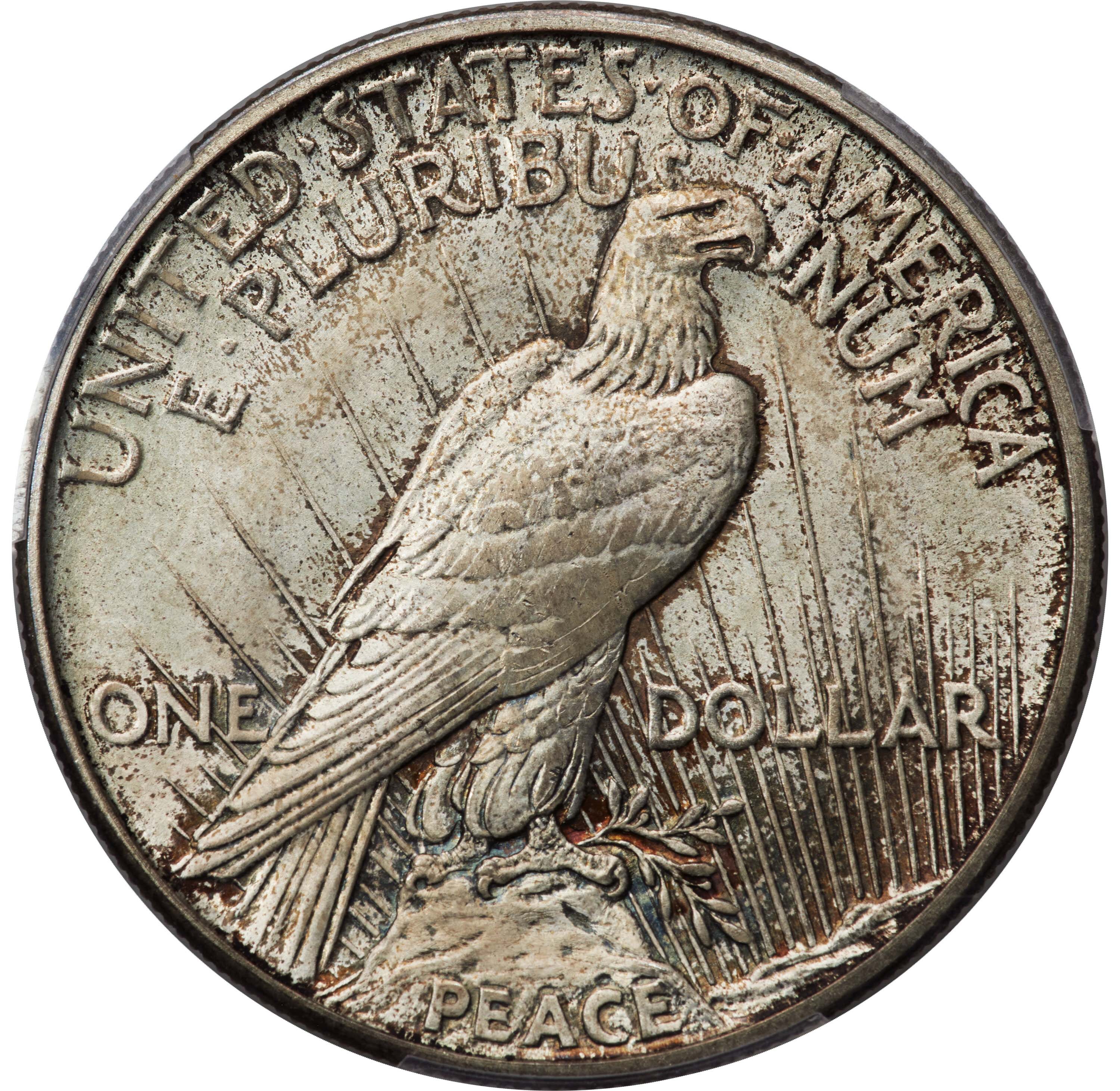
1922 $1 Modified High Relief Production Trial, Judd-2020, MS65 PCGS. CAC. Subtype 2-A. Ex: Baker Estate. A few trial coins produced during the redesign of United States coinage in the early 20th century, that are known today, are specifically and individually referenced in contemporary Mint correspondence. The present Judd-2020 Modified High Relief (or Medium Relief) Peace dollar is such a piece. In the left obverse field is its distinct feature, the number "3200" written to indicate that this was the last coin struck from the modified relief 1922 dies before they failed. A total of six Modified High Relief 1922 Peace dollars from these dies are currently documented to survive, including two proofs and four with a business strike finish. Two are in circulated condition. The following examines where these coins fit into the Peace dollar trial coinage.
The Modified High Relief
The initial 1921 circulation coinage of Anthony de Francisci's Peace dollar totaled just more than 1 million coins, which were struck in December and released into circulation on January 3, 1922. However, the coins were plagued with problems. During coinage, the high relief proved nearly impossible to strike up fully, and dies failed quickly. After release, stacking problems were discovered by banks. Mint correspondence from January 9, 1922, assigns much of these issues to the haste with which the coin was put into production at the end of 1921.
In Renaissance of American Coinage, 1916-1921, Roger W. Burdette cites the January 13, 1922 minutes of the Commission of Fine Arts, which state in part:
"... it is necessary to make certain mechanical adjustments in the dies. The mint reported that it is desirable to lower the relief to permit stacking at the banks and give greater distinction to certain portions of the coin. These changes will be made by the mint in cooperation with the designer of the coin."
A small mintage of 35,401 High Relief 1922 Peace dollars struck in early January were, according to Burdette, apparently sequestered as having the same problems at the 1921 coins, and Mint Engraver George T. Morgan immediately set out to modify the relief of the design. In late January, a batch of 3,200 coins were struck from the modified dies, but the failure of the dies once again caused Superintendent Styer to conclude that the modified design was still unsatisfactory, and a low-relief alternative was needed. In a letter to Mint Director Raymond T. Baker on January 24, 1922, Styer wrote:
"I beg to submit herewith three Peace dollars struck from the die reduced in relief. You will notice the head is lower in relief and slightly larger. It is placed a little lower in the circle. On the reverse side all the lettering has been strengthened and the rock reduced in relief. All these changes are absolutely necessary and were arrived at after considerable experimenting. I am now convinced, after we struck 3200 pieces that the eagle on the reverse side must be lowered. As you suggested, Mr. Morgan got in touch with Mr. Fraser over the 'phone and asked him to come over tomorrow. He said he had engagements that would not permit of him coming tomorrow but he expects to leave for Washington Wednesday evening and would see you there. He approves reducing the relief of the eagle and said he believed it should be reduced. In fact, he told Mr. Morgan to do what he considered necessary. He may be able to stop here on his way back to New York.
"The bright and sand-blasted pieces were of the first strike and the coin marked '3200' was the thirty-second hundredth piece struck -- the last before the die sunk. Mr. Morgan will immediately go to work on the reverse side of the hub."
James Earle Fraser's involvement was on behalf of the Commission of Fine Arts, as its resident sculptor member tasked with seeing the Peace dollar design through to coinage. In a strongly worded letter to Commission Chairman Charles Moore on January 29, 1922, Fraser spoke against the Mint's alterations to de Francisci's design, suggesting that if the relief was to be lowered, it should be done by the Janvier pantograph so that the artist's modeling would be preserved, and that if hand modifications were needed, de Francisci should be personally present for them. Ultimately, this was what occurred later, and the low-relief 1922 coinage was eventually able to commence.
The Coins Struck
What happened to the 3,200 Modified High Relief coins struck? The Mint correspondence cites three specific coins being sent to Director Baker: a sandblast proof, a "bright" or satin proof, and a coin marked "3200." Correspondence from Fraser suggests he also saw examples of the modified coinage, and Burdette reasons he may have been given "one or more of the new medium relief pieces to take with him and examine in detail." The remainder of the mintage is believed to have been melted.
Two of the coins known today carry known Baker Estate provenance: the present "3200" coin and a satin proof, both of which first appeared at auction in Stack's Bowers' August 2014 ANA sale. A lone sandblast proof is also known today, which first appeared in a 1985 Bowers and Merena sale, and which is today believed to be that sandblast proof cited in the Mint correspondence as being delivered to Baker in 1922. Of the other three coins, two are circulated. It is possible they are the remnants of however many coins were given to Fraser for examination, or they indicate that some of the mintage was allowed to go into circulation with the subsequent low-relief 1922 coinage.
The Present Coin
The ink-penned "3200" in the left obverse field is the chief element of this remarkable coin, not in it being distracting, but in it identifying this piece as the last of the Modified High Relief coinage before the dies failed. Elsewhere, the soft, luminous luster is unabraded and takes on a delicate champagne hue, with deeper russet toning clinging to the edges of the relief elements. The strike is similar to what is seen on a 1921 High Relief coin, being soft in the centers, exposing the striking problem with the design. The central weakness may also represent the beginning of the dies' failure. This piece displays unabraded surfaces, with overall preservation that is high-end for the Gem level, as the CAC green label suggests. Though one of six pieces known from these dies, it is unique with its "3200" inscription, and it is the finest of the non-proof specimens.
Ex: Delivered to Mint Director Raymond T. Baker for die trial review by Superintendent Styer (1/24/1922); Raymond T. Baker Estate; Chicago ANA (Stack's Bowers, 8/2014), lot 13618.
1880 Coiled Hair Stella, PR62
Judd-1660, Pollock-1860, JD-1
Rarest Stella Design
Ex: Kern-Carter
Sold For: $854,000.00
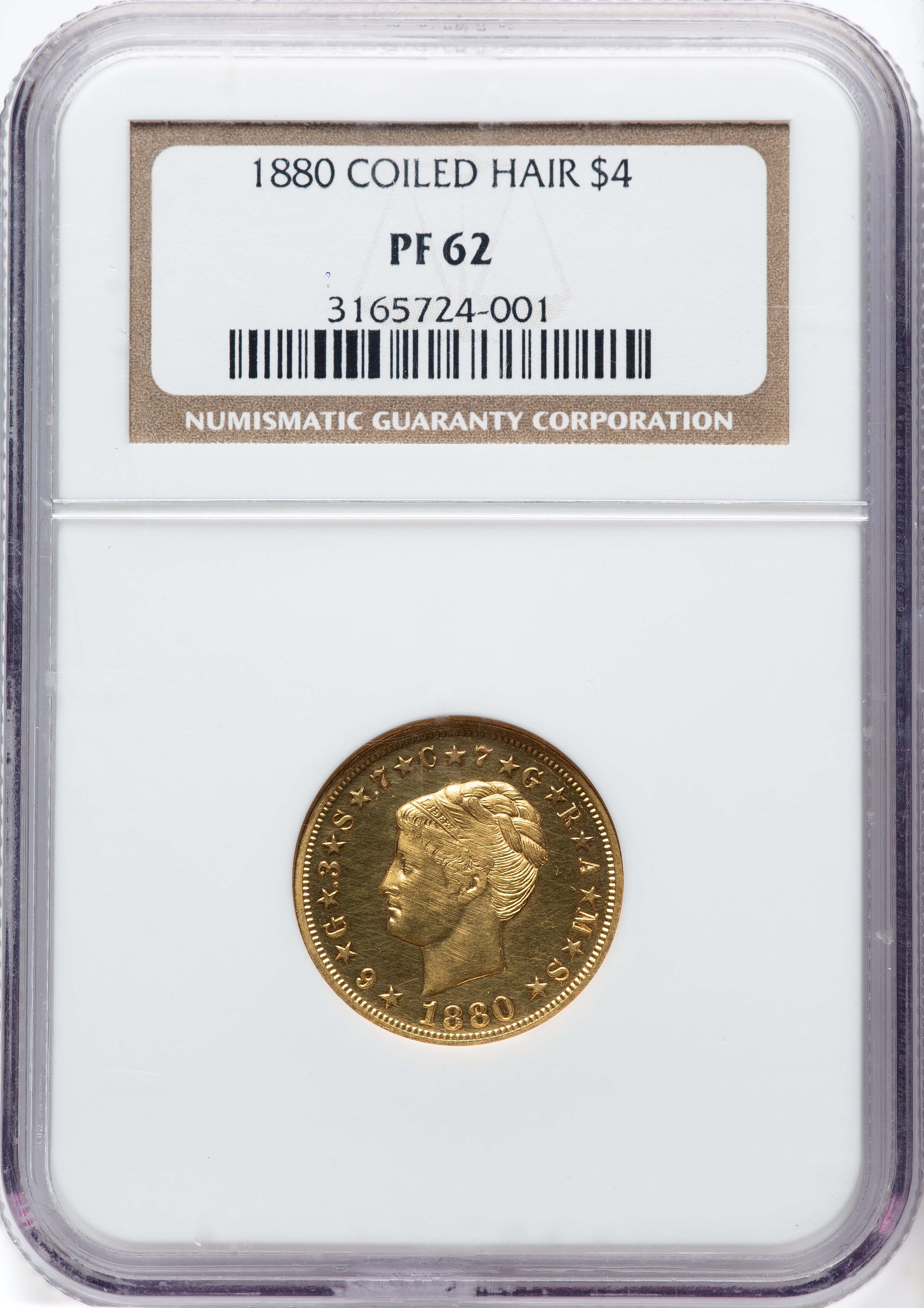
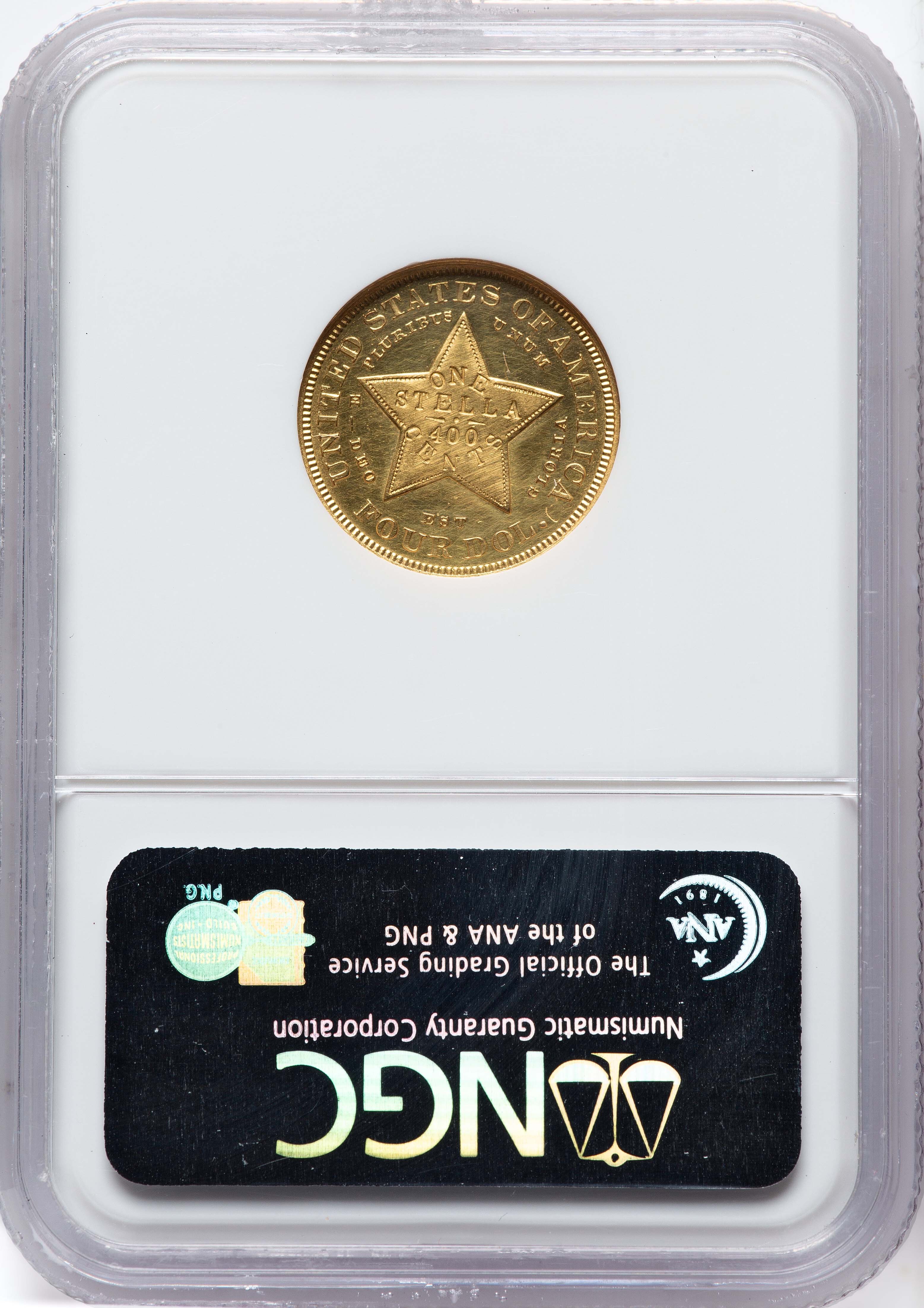
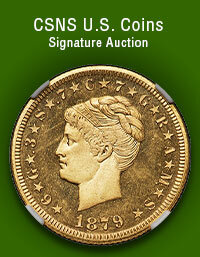
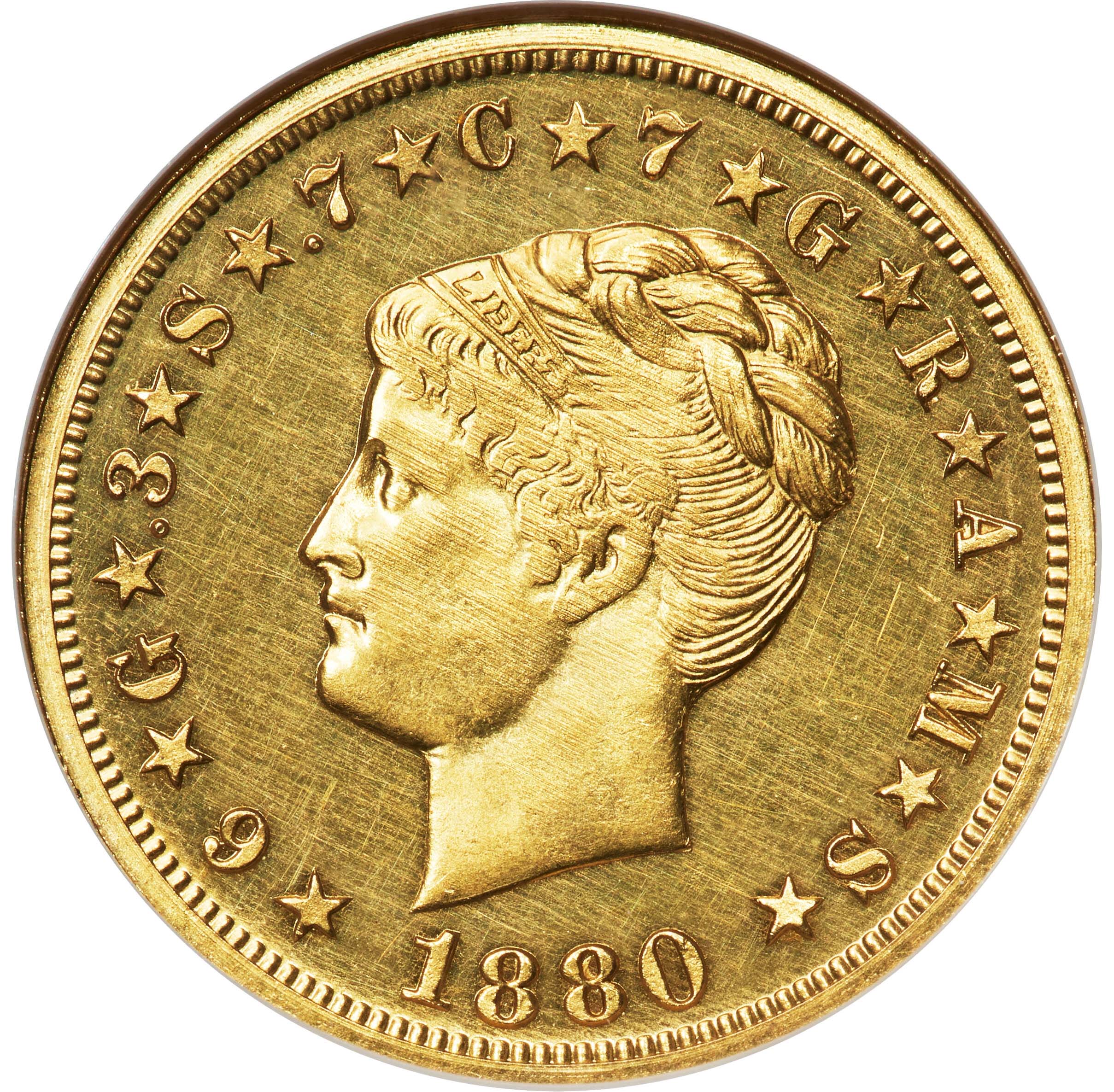
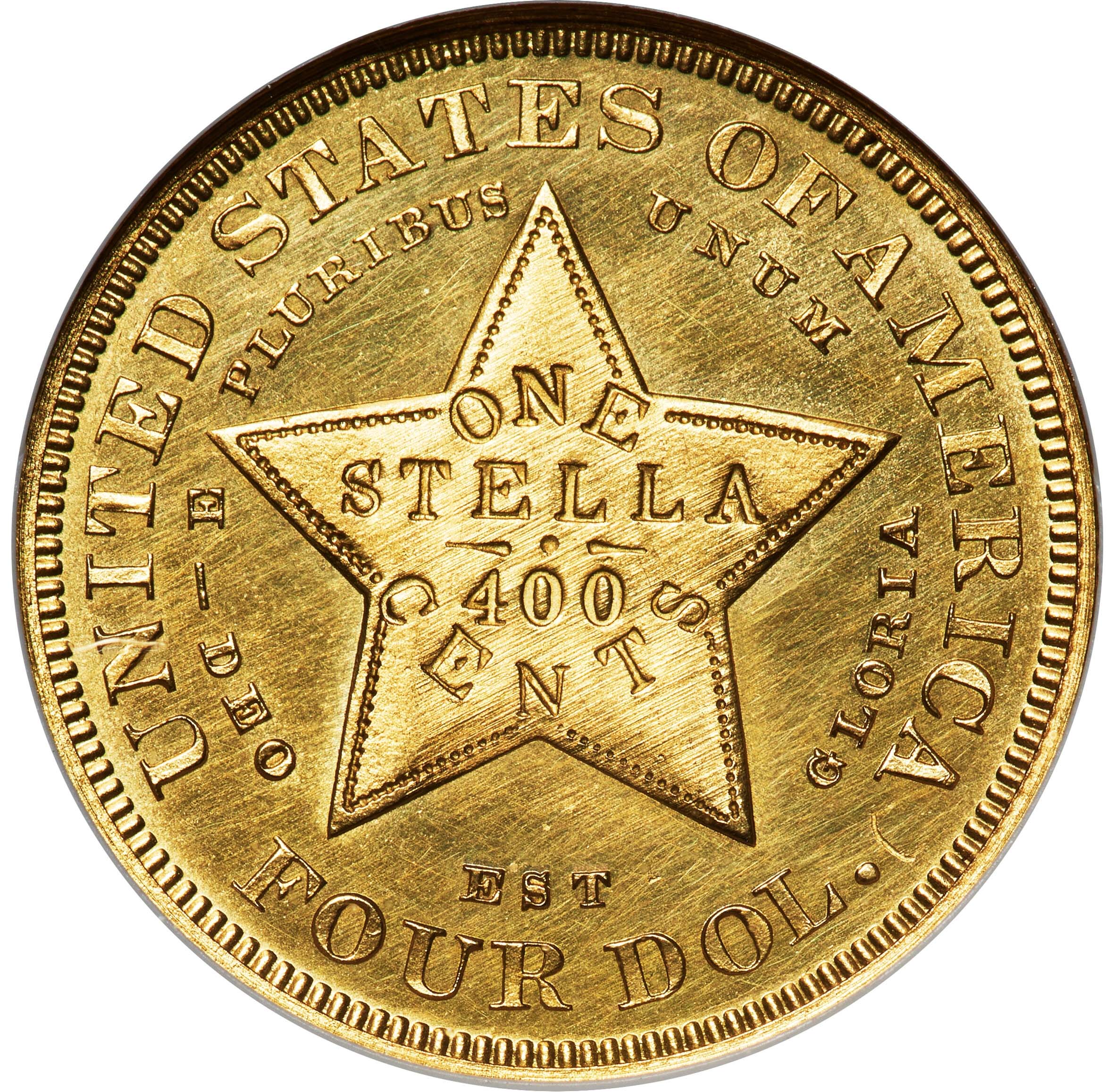
1880 $4 Coiled Hair, Judd-1660, Pollock-1860, JD-1, Low R.7, PR62 NGC. The 1880 Coiled Hair stellas (Judd-1660) are among the great rarities of American gold coinage. Only a handful of specimens survive. PCGS CoinFacts estimates the surviving population of the 1880 Coiled Hair at 8-10 examples in all grades. A roster of the 10 examples known to us is listed below, including one specimen that resides in the National Numismatic Collection at the Smithsonian Institution. Heritage Auctions is privileged to present a spectacular PR62 specimen of this classic gold pattern rarity in this important offering.
The Four Stellas
Four distinct stella varieties are known to collectors: the 1879 Flowing Hair and Coiled Hair coins and the 1880 issues of the same types. Unfortunately, while documentation regarding the purpose and production of 1879 Flowing Hair stellas is relatively comprehensive, little is known about their Coiled Hair counterparts, or even the Flowing Hair coins dated 1880. Mint records show that 425 1879 Flowing Hair stellas were struck between December 1879 and May 1880, as patterns for a proposed international coinage. There is no documentation that we know of that sheds any light on how many Coiled Hair stellas or 1880 Flowing Hair stellas were minted, who authorized their production, or why there were struck. The best estimates range from 15 to 25 examples of each type produced, with far fewer survivors known.
The 1880 Coiled Hair issue is clearly the rarest of the four varieties. It was originally issued in three-coin sets along with a goloid dollar and metric dollar, both of which were designed by George T. Morgan. For many years it was believed that just 10 pieces were struck, but it is more likely that the original mintage was slightly larger. Like the 1879 Coiled Hair and 1880 Flowing Hair coins, the 1880 Coiled Hair is definitely a major rarity from an extremely small mintage. Only the 1879 Flowing Hair stella could be called anything close to common, and that is the issue most often chosen by type collectors who want a single example of the stella. Of course, advanced specialists will want all four varieties, and are advised to take advantage of this offering.
Design
Traditionally, the Coiled Hair design has been attributed to George Morgan, but Roger Burdette puts forth a strong argument that Charles Barber was likely responsible for the Coiled Hair design, although he based it on an early pattern by Morgan (Judd-1631). Obverse: Head of Liberty faces left, her hair coiled in a bun atop her head, this coil held in place by a band inscribed LIBERTY. Around, the inscription★ 6★ G★ .3★ S★ .7★ C★ 7★ G★ R★ A★ M★ S★ and below, the date 1880 is from a curved logotype. Evidence of repunching is visible in the upper loop of the second 8 in the date. Reverse: A single large star serves as the central motif, inscribed with incuse lettering ONE STELLA 400 CENTS. Around, in small letters, are the mottoes E PLURIBUS UNUM and DEO EST GLORIA. In large letters, around the border, the legend UNITED STATES OF AMERICA above, and the denomination FOUR DOL. below. Struck in gold with a reeded edge. The D in UNITED is clearly doubled above, as it is on all four dollar gold pieces that we have seen from 1879 and 1880.
Mintages and Survival Rates
Details regarding the production of 1879 Coiled Hair stellas and both 1880 variants are scant. In fact, there are no Mint records documenting any aspect of their creation. Based on survival rates, it is fair to assume that 15 to 25 of each type were struck. Burdette speculates that the 1879 Coiled Hair stellas were struck in late October or early November 1879. Chief Coiner A. Louden Snowden likely kept the coins in reserve, in case the flowing hair design proved unpopular. They might also have been reserved for special purposes, such as exchange for coins needed for the Mint Collection or political rewards. As for the 1880-dated stellas, Burdette proposes that Snowden ordered new dies for both designs in 1880 after Burchard refused to sell unsold 1879 Flowing Hair sets to collectors, insisting they were strictly reserved for members of congress. One thing is certain beyond any reasonable doubt: The 1880 Coiled Hair stella is the rarest of the four issues in the series. Perhaps 10 examples survive (see roster below).
Physical Appearance
This coin was once a highlight of many prominent collections, including those of Jerome Kern and Amon G. Carter. This attractive PR62 example has a faint greenish tint to the pleasing yellow-gold surfaces The fields are fully mirrored, with noticeable, but not designated, field-device contrast on both sides. The design elements are well detailed, with a touch of softness on Liberty's curls, due to some planchet striations that were not completely struck out. Both sides have diagonal striations up to the left on the obverse and up to the right on the reverse, in the same direction on both sides when the coin orientation is considered. Those striae result from the original planchet manufacturing process. Standard half eagle planchet strip was reduced to 80% thickness in the Mint's rolling mills and drawing bench, then planchets were cut using the standard half eagle planchet cutter. It was the process of rolling and drawing the planchet stock that left parallel striations on the planchet strip. We have never seen a gold stella without the striae, although on some it is extremely faint. This coin possesses a winning combination of absolute rarity, outstanding eye appeal, and intense historic interest. It will be a welcome addition to the finest collection or type set. The 1880 Coiled Hair stella is listed among the 100 Greatest U.S. Coins. NGC Census: 1 in 62, 3 finer (2/26).
Roster of 1880 Coiled Hair Stellas
This roster was compiled from earlier work by John Dannreuther, Ron Guth, and Saul Teichman.
1. Eliasberg Specimen. PR67 Cameo NGC. H.P. Smith Collection (S.H. & H. Chapman, 5/1906), lot 1456, part of a three-piece Goloid set, with the coins offered in individual lots; J.M. Clapp; Louis E. Eliasberg, Sr.; Louis E. Eliasberg, Jr.; United States Gold Coin Collection (Bowers and Ruddy, 10/1982), lot 319, realized $99,000; Holecek Family Trust (Stack's, 10/2000), lot 1625; Paramount Collection; U.S. Coins Signature (Heritage, 2/2021), lot 3754, realized $1,860,000; FUN Signature (Heritage, 1/2026), lot 3212, $2,074,000.
2. Delp Specimen. PR67 Cameo NGC. Winner Delp Collection (Stack's, 11/1972), lot 792, realized $35,000; Summer FPL (Stack's, 1997) offered as part of a four-piece set for $875,000; FUN Signature (Heritage, 1/2005), lot 30044, realized $977,500; Tacasyl Collection (Bonhams, 9/2013), lot 1011, realized $2,574,000.
3. DuPont Specimen. PR67 NGC. CAC. S. Hallock du Pont Collection (Sotheby's, 9/1982), lot 252, part of a four-piece set of stellas with the coins offered in individual lots, realized $102,300; Chicago Sale (Superior, 8/1991), lot 707, realized $440,000, Central States Signature (Heritage, 4/2015), lot 5301, realized $1,821,250; ANA U.S. Coins Signature (Heritage, 8/2025), realized $2,280,000.
4. Trompeter Specimen. PR65 Cameo PCGS. CAC. Will Neil Collection (B. Max Mehl, 6/1947), lot 2605, sold as part of a set for $3,850; Grant Pierce; 1976 ANA (Stack's, 8/1976), lot 2920, sold as part of a set for $225,000; Western Collection (Stack's, 12/1981), lot 1139, realized $135,000; Ed Trompeter Collection (Superior, 2/1992), lot 136, realized $264,000; Orlando Sale (Superior, 8/1992), lot 599; 60th Anniversary Sale (Stack's, 10/1995), lot 1548, realized $308,000; Long Beach Signature (Heritage, 6/2015), lot 4230, realized $1,116,250.
5. Simpson Specimen. PR65 Cameo PCGS. Memorable Collection (Numismatic Gallery, 3/1948), lot 282; Public Auction Sale (Stack's, 3/1999), lot 136; Rarities Sale (Bowers and Merena, 1/2000), lot 352; Bob R. Simpson Collection.
6. Superior Galleries Specimen. PR64 Cameo PCGS. Richmond Collection (David Lawrence, 7/2004), lot 1306; Santa Clara Sale (Superior, 7/2005), lot 425, realized $618,125.
7. Kern Specimen. PR62 NGC. Golden Jubilee Sale (B. Max Mehl, 5/1950), lot 245, sold as part of a set for $4,100; Amon Carter, Sr.; Amon Carter, Jr.; Carter Family Collection (Stack's, 1/1984), lot 634, realized $72,250; FUN Signature (Heritage, 1/2009), lot 4035, realized $575,000; Los Angeles Signature (Heritage, 7/2009), lot 1246, realized $546,250. The present coin.
8. Davies Specimen. PR61 NGC. Davies-Niewoehner Collections (Paramount, 2/1975), lot 547, realized $67,500; Bowers and Ruddy Rare Coin Review #26, p. 64; FUN Signature (Heritage, 1/2000), lot 7519; Robert Swan & Rod Sweet Collections (Bowers and Merena, 3/2004), lot 2620.
9. Dallas Bank Specimen. PR61 NGC. Dr. John Wilkison; Tennessee Coin Exchange; Julian Leidman and Mike Brownlee; Paramount International Coin; H. Jeff Browning; Dallas Bank Collection (Sotheby's and Stack's, 10/2000), lot 363; Rarities Auction (Stack's Bowers, 10/2015), lot 110, realized $258,500; The Poulos Family Collection/ANA Signature (Heritage, 8/2019), lot 3862, where it brought $204,000; FUN Signature (Heritage, 1/2022), lot 4692, realized $504,000.
10. Lilly Specimen. PR64. Josiah K. Lilly; National Numismatic Collection at the Smithsonian Institution, grade per Garrett and Guth.
Additional Appearances
A. Proof. Dewitt Smith; sold to Virgil Brand in 1908, Brand Journal number 46965.
B. Proof. Edgar Adams; sold to Virgil Brand in 1911, Brand Journal number 57094.
C. Proof. F.C.C Boyd; sold to Virgil Brand in 1921, Brand Journal number 105730.
D. Proof. Albert A. Grinnell Collection (B. Max Mehl, 6/1943), lot 187; Fred E. Olsen Collection (B. Max Mehl, 11/1944), lot 621, part of a four-piece set of stellas with the coins offered in individual lots.
E. Proof. King Farouk; Palace Collections of Egypt (Sotheby's, 2/1954), lot 323, purchased by Baldwin.
F. Proof. Public Auction Sale (Kreisberg-Schulman, 2/1961), lot 1150, part of a four-piece set of stellas.
G. Proof. Major Lenox Lohr; Abner Kreisberg; James Ruddy; Lohr Fixed Price List (Empire Coin Company, 1961).
H. Proof. Possibly Dr. J. Hewitt Judd; Illustrated History of United States Coins (Abe Kosoff, 1962), lot 566.
I. Proof. Golden Sale of the Century, Part II (Kreisberg-Schulman, 1/1963), lot 1940, part of a four-piece set of stellas, with the coins offered individually(Registry values: P4)
From The Presidio Collection, Part II.
(1854) Kellogg Twenty Copper Die Trial
Extremely Rare K-1 Variety, MS64 Brown
Ex: Virgil Brand
Sold For: $134,200.00
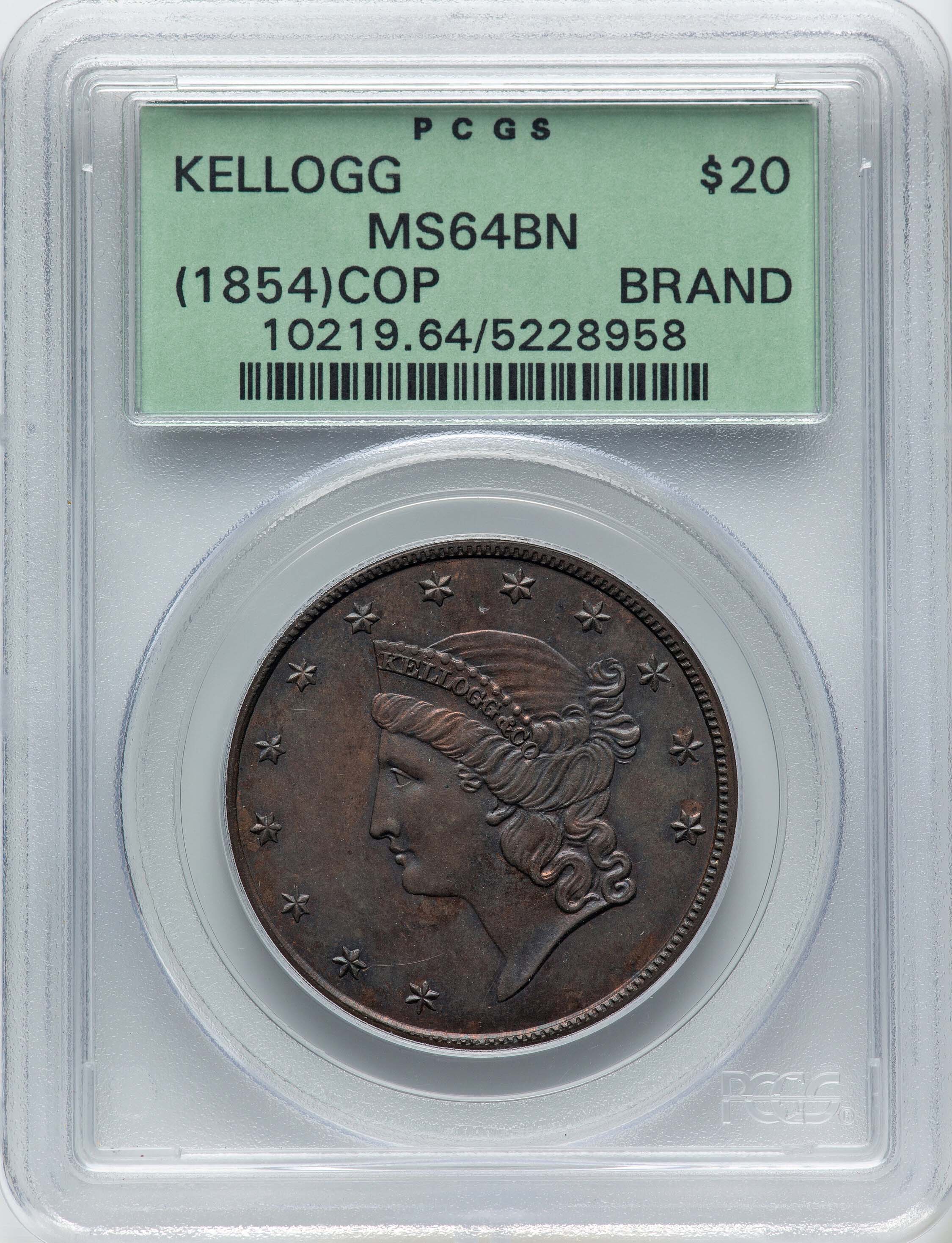
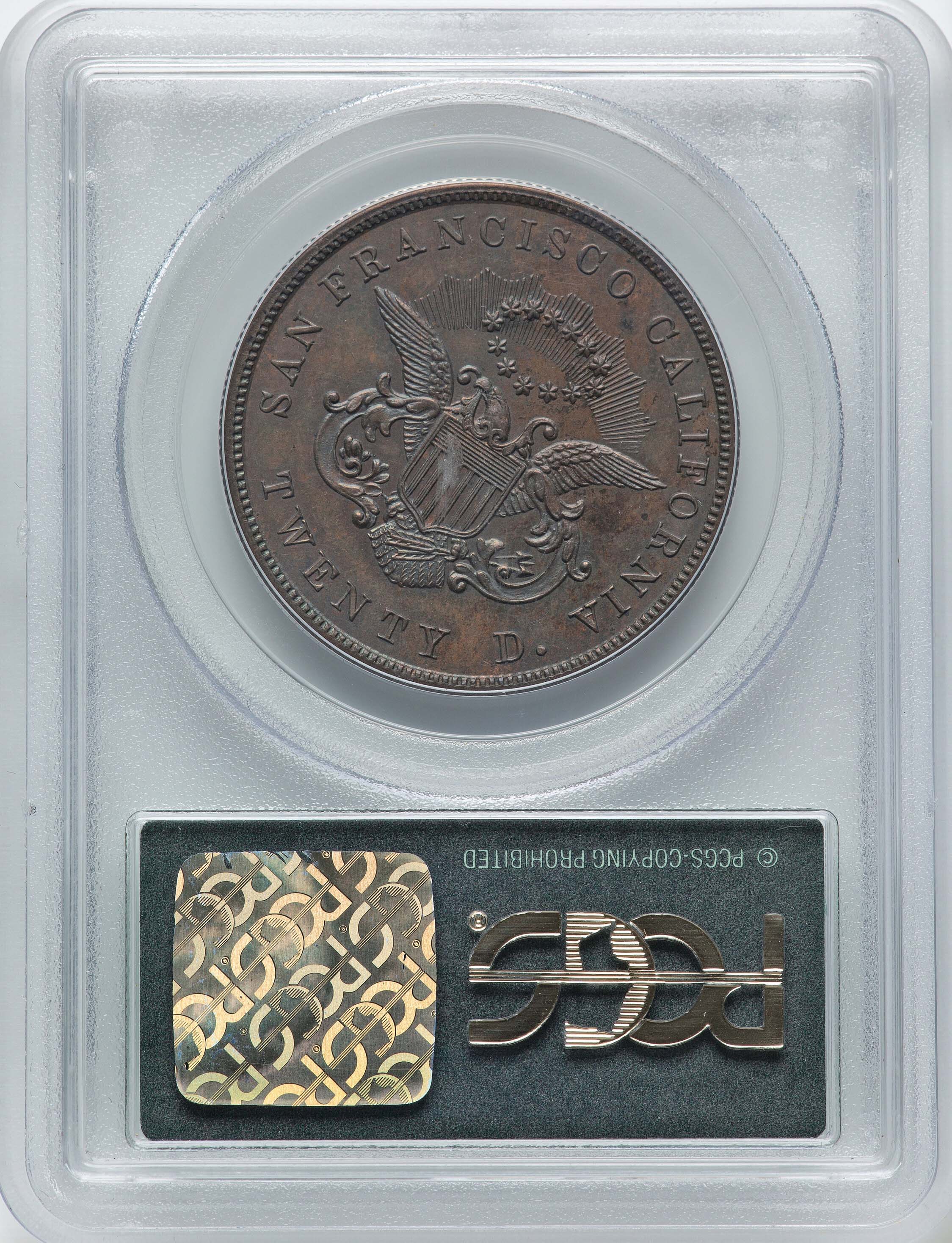
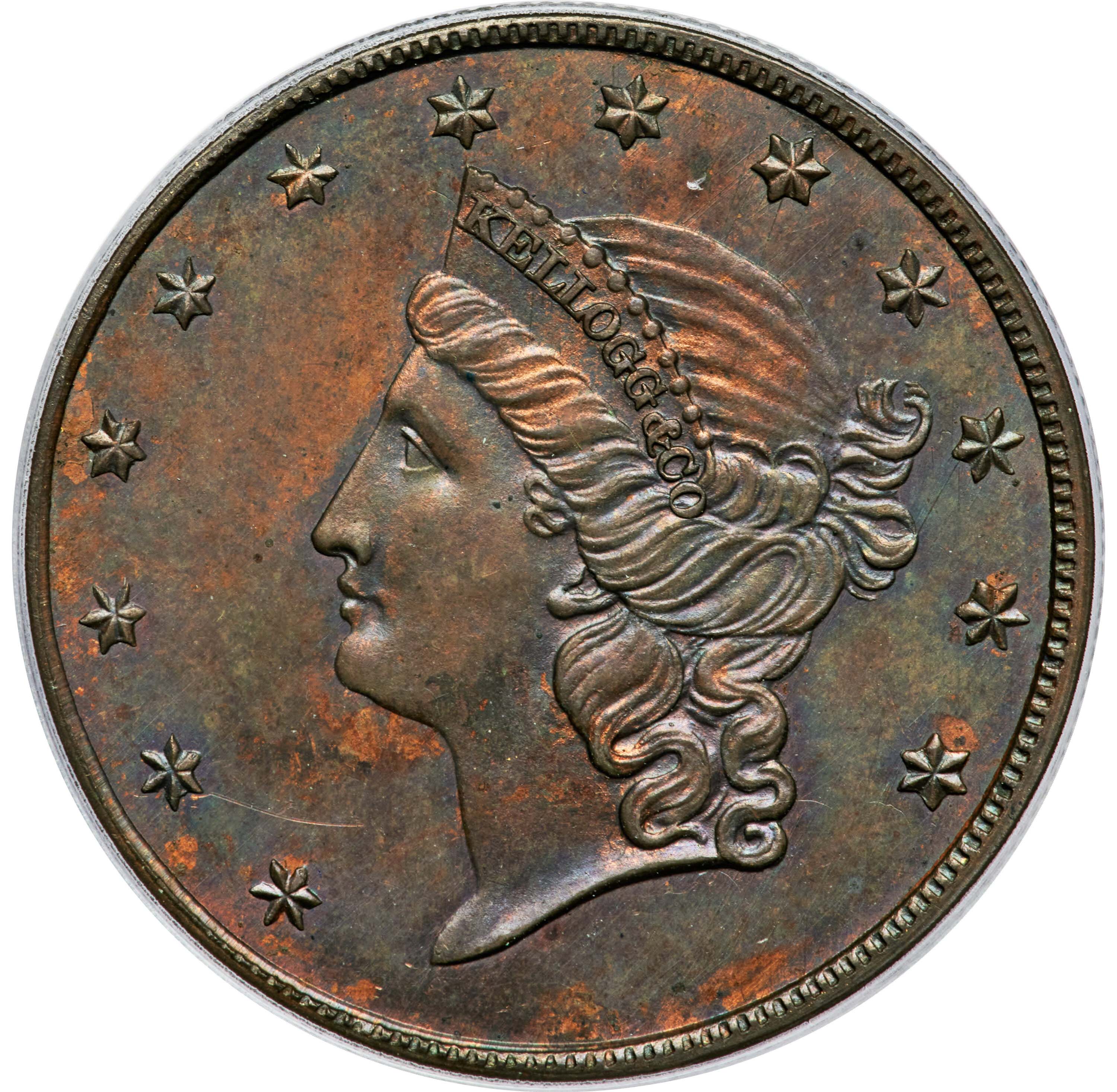
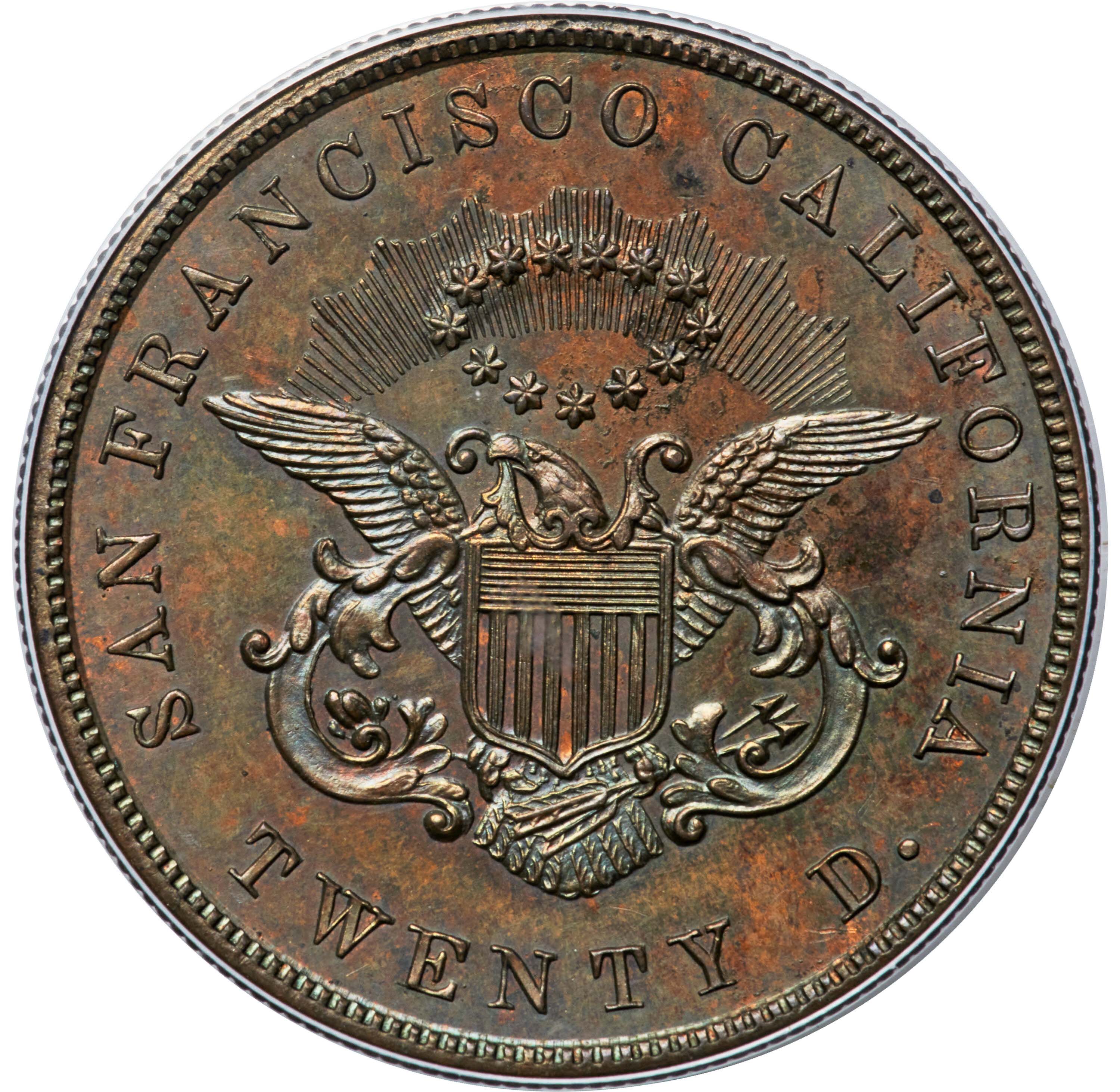
1854 $20 Kellogg Twenty Dollar Copper Die Trial MS64 Brown PCGS. K-1. The closing of the United States Assay Office on December 14, 1853, and the lack of private coinage created a coin shortage in California, and while paper money could have alleviated the issue, the state's constitution made paper currency illegal. What coins survived the second series of private coinage dwindled, all while high-grade bullion continued flowing to the state. The desperate bankers approached John Glover Kellogg and G.F. Richter to help alleviate the ailing bankers who wrote on January 14, 1854 in Alta California:
"...bankers in this city and Sacramento addressed a communication to Merssrs. Kellogg & Richter, Assayers stating that there was a scarcity of coin here and desiring them to issue private coin until the commencement of operations in the Mint... they have acceded to their request, will commence their coming operation in a few days."
Kellogg & Co. proceeded to strike approximately 300,000 twenty-dollar gold coins in 1854 and 1855, using dies that closely resembled those used for regular federal coinage. The legends were altered so that they reflected the issuing company and place of striking. The operation of the newly opened San Francisco Mint should have concluded the need for private assaying in the Golden State, but operations proved spotty initially. The new Mint was met with both shortages and failing equipment, which only hastened a coin shortage crisis that the federal government was now unable to relieve, only furthering the reliance on Kellogg & Co.'s private issues.
Don Kagin lists the K-1 copper die trial as an R.8 issue in his definitive reference on Territorial gold. This extremely rare, undated copper dies trial was struck before the date was added to the die. They are, according to Kagin, made from modified dies from Curtis & Perry's 1853-Moffat double eagles. We can largely conclude that the trial pieces were struck early in 1854, as the request from bankers issued to Kellogg took place January 14, 1854, and the first gold double eagle issued from the company was February 9th, we can safely assume it was struck within that twenty-six-day window.
The earliest auction appearance of an example known to us was in 1890 as an offering in the Lorin G. Parmelee Collection, though the catalog said nothing of note and reported it as Uncirculated. The first example that we can trace to a currently known specimen was the Garrett coin, sold privately by B. Max Mehl in 1937 and went on to appear 43 years later in the Garrett Collection Bowers and Ruddy auction in March 1980; they cited Don Taxay's compilation of Scott's Encyclopedia of United States Coins, which stated: "...two pieces with certainty, and mentions a possible third." Another example emerged in the Henry H. Clifford Collection, offered by Bowers and Ruddy in March 1982, where the cataloger reported the same population estimate.
The third known example is the current coin. It was part of Virgil Brand's collection, offered by Bowers and Merena in 1984. While Bowers and Merena adjusted their estimate in that catalog to "...fewer than a half dozen exist...," no previously unknown examples have appeared at auction since. Thus, only three pieces are known today. There are some noted early appearances (see roster below), that were mentioned within other sales, which cannot be positively matched to any of the three known examples. They likely represent early offerings of these pieces or additional examples yet to emerge in modern times.
The Brand specimen offered here displays deep espresso-brown luster intertwined with some chestnut tones. There are no readily apparent abrasions or marks that would detract from the incredible eye appeal of this piece. The strike of this trial is exquisite, and some hatch patterned die lines appear above the hair.
The other two known specimens have not appeared publicly in decades. The Garrett example was the most recent of them to appear, graded PR65 by NGC and offered 25 years ago in a Bowers and Merena auction. The Clifford piece has not been publicly offered since 1982. The present Brand example is the only example of this elusive pattern that has had the opportunity to be offered just twice since then. This will be the first opportunity to obtain this example in over a decade. Heritage will have the privilege to offer this historic die trial piece. Housed in a generation 3.1 green label holder.
Roster of Known Specimens
1. PR65 Brown NGC. B. Max Mehl, sold privately on 4/6/1937; John Work Garrett Collection; Johns Hopkins University Collection; Garrett Collection, Part II (Bowers & Ruddy 3/1980), lot 907, $8,000; Phillip Flannagan et al, Collections (Bowers & Merena, 12/2001), lot 6549, not sold. Kagin plate coin.
2.MS64 Brown PCGS. Chicago Coin Company, purchased on December 30, 1911; Virgil Brand, inventory number 60,760; Jane Brand Allen; The Virgil M. Brand Collection Part II (Bowers and Merena, 6/1984), lot 1547; FUN Signature (Heritage, 1/2012), lot 5152, $80,500. The present coin.
3. Unc Details (scratched) NCS. Henry H. Clifford Collection (Bowers and Ruddy, 3/1982), lot 52; Jack Klauson; Kagin's; private transaction in 6/1992 to the Robert Bass Collection of Pioneer Patterns (coin #88). Thanks to Saul Teichman and David McCarthy for this information.
Additional Appearances
A. Uncirculated. Lorin G. Parmelee Collection (New York Coin & Stamp, 6/1890), lot 256, $1.10; Lyman Low. Possibly the same as number 1 or 2 above.
B. Uncirculated. Hercsh, Levick, and Farrell Collections (Thomas Elder, 10/1907), lot 452, $17; Henry Chapman. Possibly the same as number 1 or 2 above.
C. Very Fine. H.O. Granberg Collection in 1911, per Edgar Adams, plate coin in his Private Gold Coinage of California 1849-1855. Possibly the same as number 3 above.
D. In the Scott Catalogue & Encyclopedia of U.S. Coins, Don Taxay lists an example attributed to Ely. No other information available.
E. Another example Taxay mentions as a possible appearance attributed to Haines-Wiggin. No other information available.
Kellogg & Humbert Gold Ingot, 23.33 Ounces
Ex: S.S. Central America
Sold For: $122,000.00
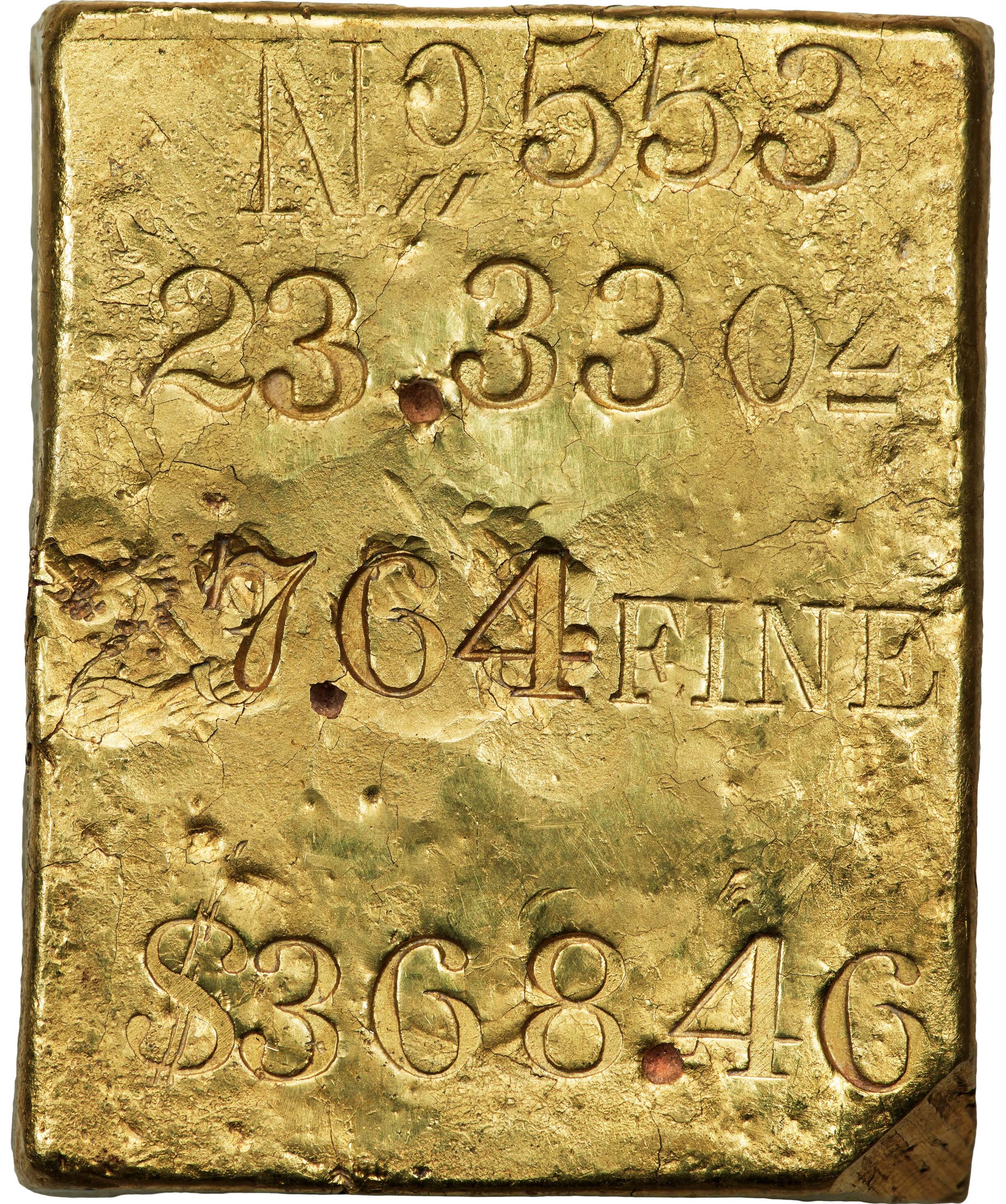
Kellogg & Humbert Gold Ingot. 23.33 Ounces. CAGB-457. Even after the S.S. Central America shipwreck in 1857, where hundreds of Kellogg & Humbert gold ingots were lost, contributing to the financial Panic of 1857, the San Francisco assayer continued to be a prolific private firm on the West Coast. The October 5, 1859 edition of The Nevada Democrat ran a short notice concerning the firm:
"Messrs. Kellogg & Humbert, assayers of San Francisco, have recently cast the largest bar of gold ever made in California, and perhaps in the world. It is twelve inches long, fine and a half wide, and four thick, and perfectly cast without dressing or burnishing. It weighs 2,122 25-100 ounces [2,122.25 ounces], and is valued at $42.581 71."
The cited ingot dwarfs any of the those recovered from the S.S. Central America, though, it is not available to collectors today to own. Most known ingots from Kellogg & Humbert, as well as other California assayers, came from the 1857 shipwreck. These are accessible, though they appear at auction with irregularity, meaning collectors must be ready when an opportunity arises.
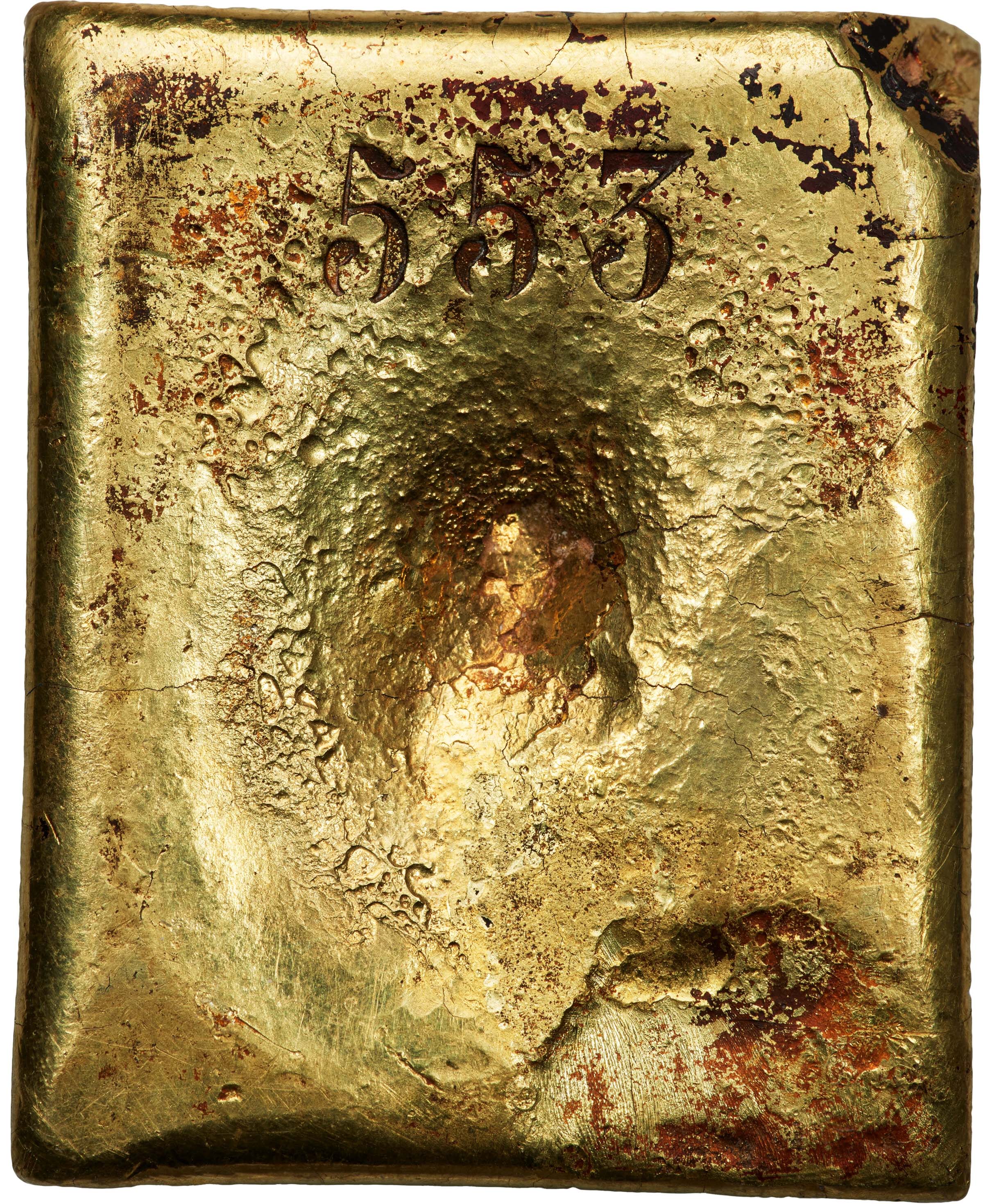
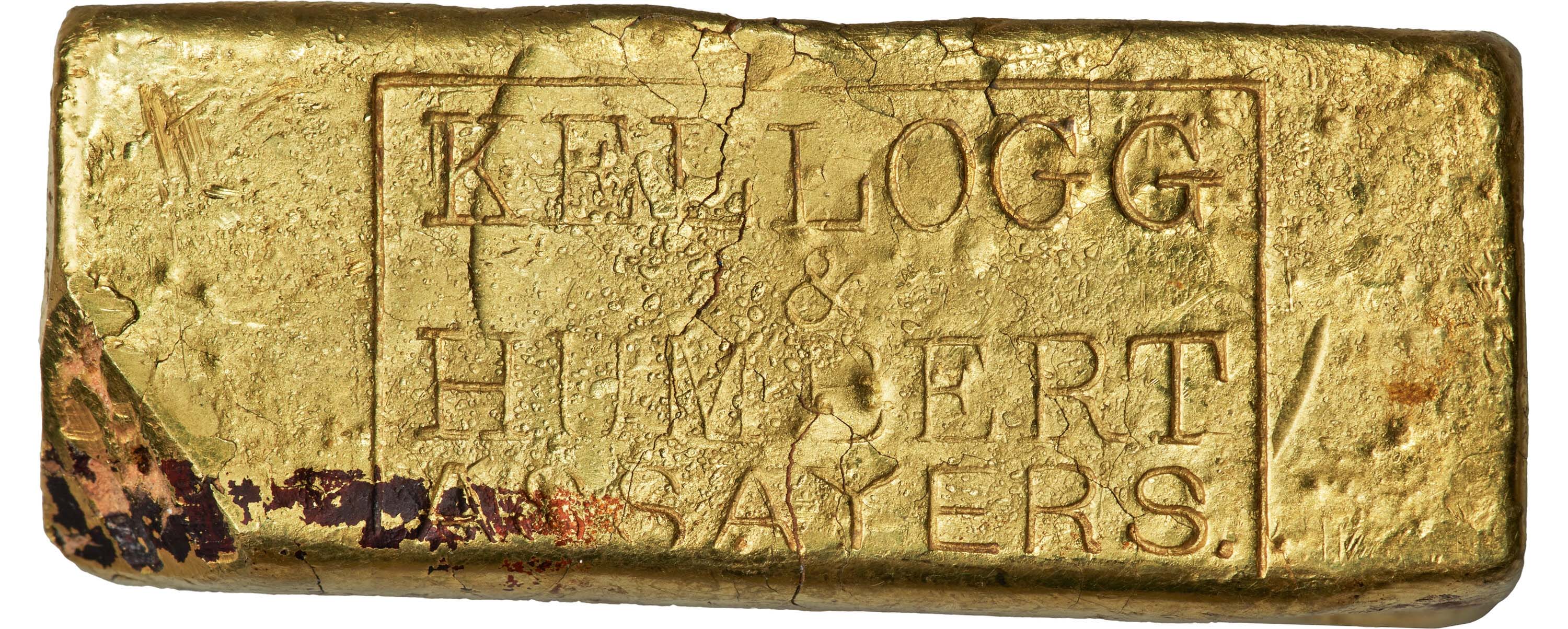
This ingot is among the smaller Kellogg & Humbert bars recovered from the wreck. It was poured into Mold K&H-02 (41 mm x 52 mm) and weighs 23.33 troy ounces. This is a small-to-medium-sized ingot (weight class of 15.01 to 25.00 ounces). The top side reads: No 553 / 23.33 Oz / 764 FINE / $368.46. The company hallmark is placed on a long side. The serial number is repeated on the back side of the ingot. The ingot is primarily yellow-gold but with reddish deposits on portions of the back and lower edges. Surface marks are minor and consistent with S.S. Central America recovery ingots. Thickness: 21 mm.