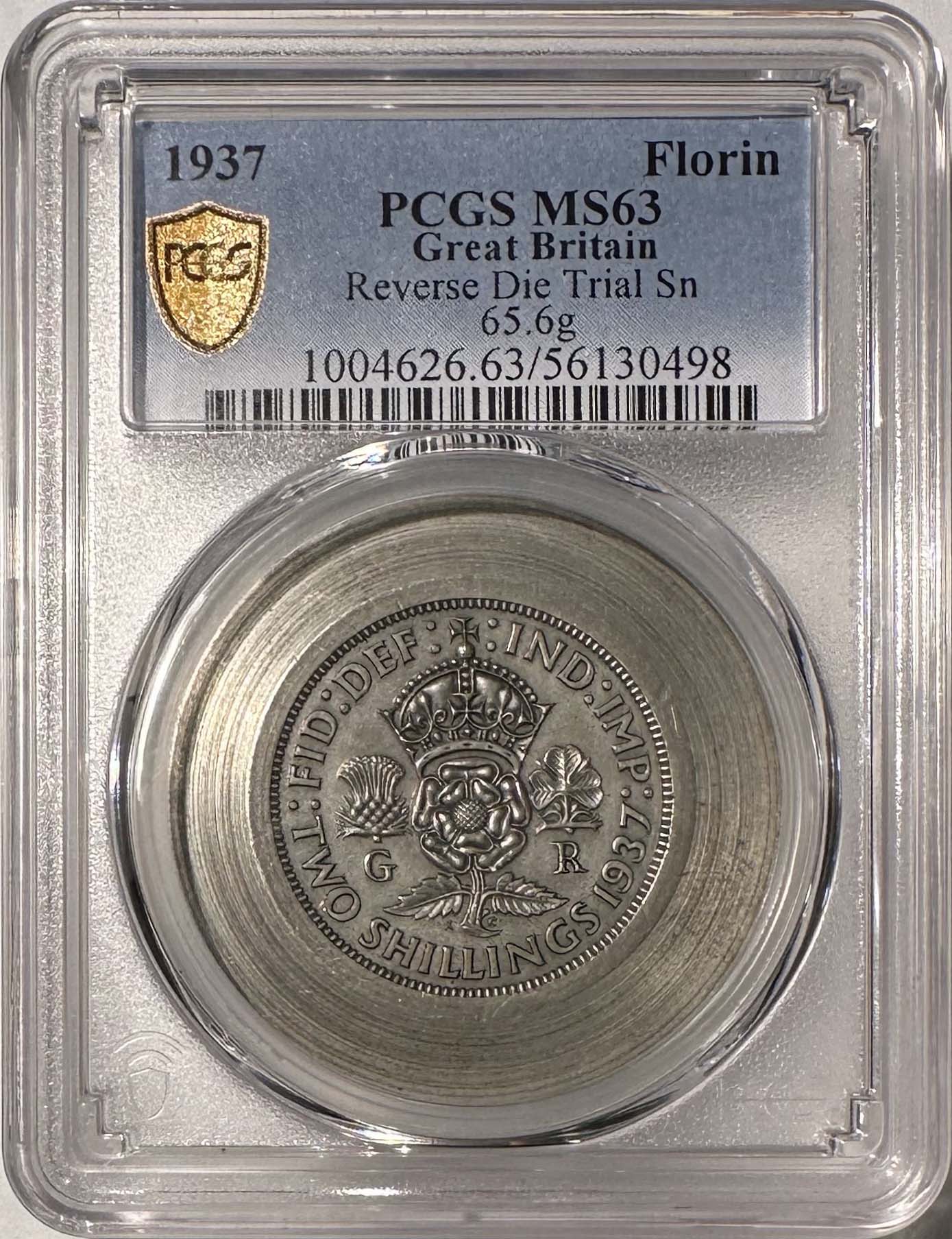

This is a historic numismatic treasure! It is a unique 1937 Great Britain Florin (Two Shillings) reverse die trial, which has been authenticated and certified by PCGS. Although graded MS 63, it is virtually as struck. It is a uniface impression from the master die (matrix) of the reverse design. There are lathe rings visible on both the obverse and reverse. It was struck prior to producing the hubs and dies.
It weighs 65.6 grams, and has a diameter of 40 mm, with a thickness of 6 mm. It was struck in tin on two pieces of metal joined together around the perpendicular plain edge. PCGS encapsulated this unique die trial in a special holder. It is one of the most dramatic and unique die trials that I have ever encountered in my 50 years as a professional numismatist specializing in mint errors, die trials, and patterns.
In January 1936, Edward VIII became king. On December 10th of the same year, he signed an Instrument of Abdication, giving up the throne. Edward's brother Albert was next in line and was crowned King George VI.
The Royal Mint had scheduled to produce coins of Edward VIII, commencing on January 1, 1937. His abdication prevented the Royal Mint from ever issuing coinage in his name. There were a few patterns struck in 1936 in preparation for his coinage in 1937. The patterns of Edward VIII are world famous and bring record prices when they are offered for sale. In a recent auction, a 1937 Gold Pattern 5 Pound in Proof, of Edward VIII, realized $2.28 million.
King George V reigned from 1927-1936. The Florin featured his portrait on the obverse and a cross of crowned scepters and shields on the reverse.
After his death, the Royal Mint produced a new design for the Florin for King Edward VIII. The obverse portrays his portrait and the reverse depicts a crowned Tudor rose, a thistle with the letter E underneath, and a shamrock with the letter R underneath.
When King Edward VIII abdicated, the Royal Mint used the same Florin reverse design for George VI, only changing the E to G.
This impression from the master die was struck prior to producing the hubs, working dies and dies. It is a part of Great Britain's numismatic history, a unique die trial transitioning from King Edward VIII to King George VI, and truly belongs in the Royal Mint Museum or in a world class collection of English coinage.

It weighs 65.6 grams, and has a diameter of 40 mm,
with a thickness of 6 mm. PCGS encapsulated
this unique die trial in a special holder:

Click here for more information from the
Royal Mint Museum on the coin design process...
Die Trials are featured in
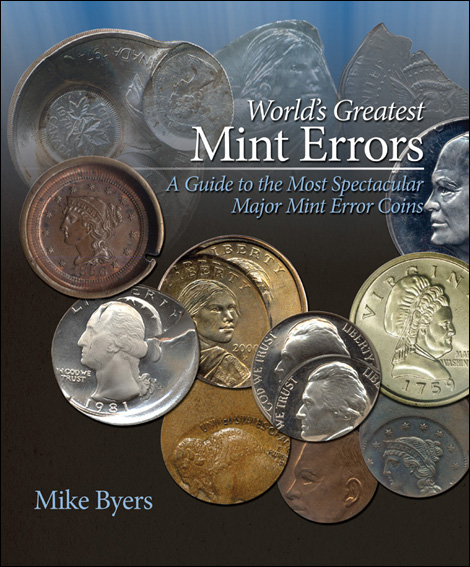
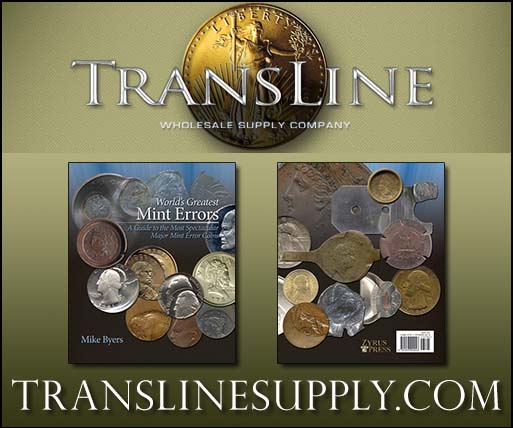
my NLG Award winning book,
World's Greatest Mint Errors.